Artificial intelligence in learning, and in life? Yes, no, and maybe

Student panelists taking part in the May 5 conversation on AI in education hosted by Lewis and Clark Community College were, from left, Julia Janus, Roland Gonzalez, Ethan Micklevitz and Wrigley Releford. (Melissa Crockett Meske/Illinois Business Journal)
By MELISSA CROCKETT MESKE
Managing Editor, Illinois Business Journal
[email protected]
A student-led discussion on the impact of artificial intelligence on education was recently hosted at Lewis and Clark Community in Godfrey. Offered as both an in-person and virtual conversation between panelists and participants, the dialogue solidified more than anything else that there are still a lot of pros and cons when it comes to AI, and still much unknown.

Lewis & Clark President Kent Trzaska (IBJ file photo)
Facilitated by LC President Ken Trzaska and the President’s Student Advisory Council, there were four student panelists and four faculty panelists to lead the May 5 talk, moderated by Councilmembers Jacob Wicker and Lashod Robinson.
It was pointed out that Lewis and Clark already has AI policies in place, however the use of it as a tool in both teaching and learning has continued to evolve.
“AI is already part of our everyday lives,” noted Trzaska. “As we continue to grow and evolve as a college, AI will be part of that journey. How we use AI as a tool for success will become increasingly important, especially as it relates to ethics and the integrity of its use.”

2025-26 LC Student Trustee Jim Eck (IBJ file photo)
LC Student Trustee Jim Eck, serving in his role as the 2025-26 representative for the student body on the college’s board of trustees, said the purpose of the panel discussion was to feature faculty and students sharing their thoughts and experiences, but also to engage community members who also share their own perspectives.
“The key to building effective use of any new tool is understanding its power, limitations, and risks. This discussion leads us on that path of understanding,” said Eck. “There is no debate that AI will influence, and is already influencing, the education and employment environments.
“As a community college, we need to adapt our techniques for studying and teaching so that we harness the power of AI to enhance our experiences, knowledge and expertise,” Eck added. “As students enter the workforce, having skills to be able to deploy AI to create value and solutions will be a differentiator.”
The hour-long discussion took place starting at 2 p.m. on Tuesday afternoon, May 5, in the Ahlemeyer Atrium in the Trimpe Advanced Technology Center on the Godfrey campus. Participants also joined via Zoom.

Councilmember and Moderator Jacob Wicker (LC photo)
Student panelists included Julia Janus, Roland Gonzalez, Ethan Micklevitz and Wrigley Releford.
Faculty panelists were Associate Professor of Accounting and Business Division Coordinator Christina Wickenhauser, Mass Communication Station Engineer/Audio Visual’s David Ollenbittle, Professor of English Francis Corby and Professor of Speech Mumba Mumba.
The panel discussion took a deep dive into AI’s role in education, concluding that AI is a powerful learning tool that should augment—not replace—human thinking and teaching.
Student panelists noted that they are using AI primarily for tutoring, assignment clarification, and time management. Breaking down complex assignments, tutoring during unconventional hours, applying grading rubrics against assignments before they are submitted, generating practice questions and even simply finding synonyms they can use so their written work becomes less repetitive and more professional were among the most noted uses of AI by students.
Faculty panelists shared that they are using it for activity creation and business-related tasks. Examples cited included creating business logos, writing proposals and optimizing information searches beyond traditional Google results are applications faculty noted for AI.
Ethical concerns and guidelines were also a part of this important conversation. Proper use principles noted: Never copy and paste AI output directly; use AI to enhance learning, not replace personal thought; and for students to maintain originality and critical thinking to avoid cognitive offloading.

Councilmember and Moderator Lashod Robinson (LC photo)
Other proper uses noted were to prompt AI to disagree or challenge ideas rather than only to validate them; use AI-generated scripts as launch points for creative production work; and to assign exercises requiring students to critique and verify AI outputs using critical thinking.
There were also relevant concerns raised regarding job displacement. Students noted that “AI replacement fears” were causing some to reconsider going into creative fields such as music production and graphic design because of the possibility there will not be jobs for them in the future. Research careers are also of concern for this same reason.
Career opportunities are evolving in artificial intelligence fields, however. Among the noted career paths: AI trainers and consultants for organizations; verification and quality control roles for AI output; and interlibrary loan and related research opportunities created by technology advancements.
It was further pointed out that healthcare fields offer “protected” career opportunities as well as those requiring direct physical human input such as automotive technology, plumbing, welding and other trades.
Some important unresolved concerns listed out by the panelists, as well as from audience members, involved whether or not AI might replace teachers in the future, how therapists and counselors are managing with AI “competition,” what specific jobs AI will create, and how to balance AI efficiency with human creativity.
AI represents a revolutionary technology comparable to the printing press or automobile. Ideally, AI is used to help others and build up society. Users are cautioned against losing their own critical thinking skills through a reliance on artificial intelligence and should keep the environmental impact of its use top of mind.
At the end of the hour, the consensus leaned toward this:
AI must be used ethically in education, with clear policies, and students must be diligent in maintaining critical thinking skills and originality.
The same might be applied to all of society.
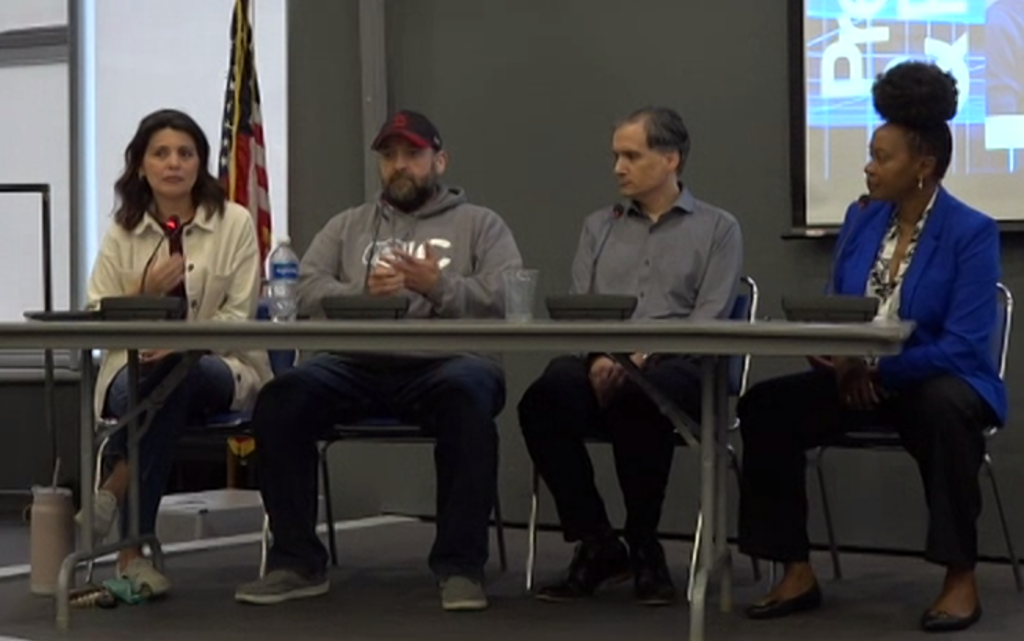
Faculty panelists taking part in the May 5 conversation on AI in education hosted by Lewis and Clark Community College were, from left, Associate Professor of Accounting and Business Division Coordinator Christina Wickenhauser, Mass Communication Station Engineer/Audio Visual’s David Ollenbittle, Professor of English Francis Corby and Professor of Speech Mumba Mumba.(Melissa Crockett Meske/Illinois Business Journal)
Related Posts