Careers in view: Ameren Illinois’ Patrick E. Smith Sr.
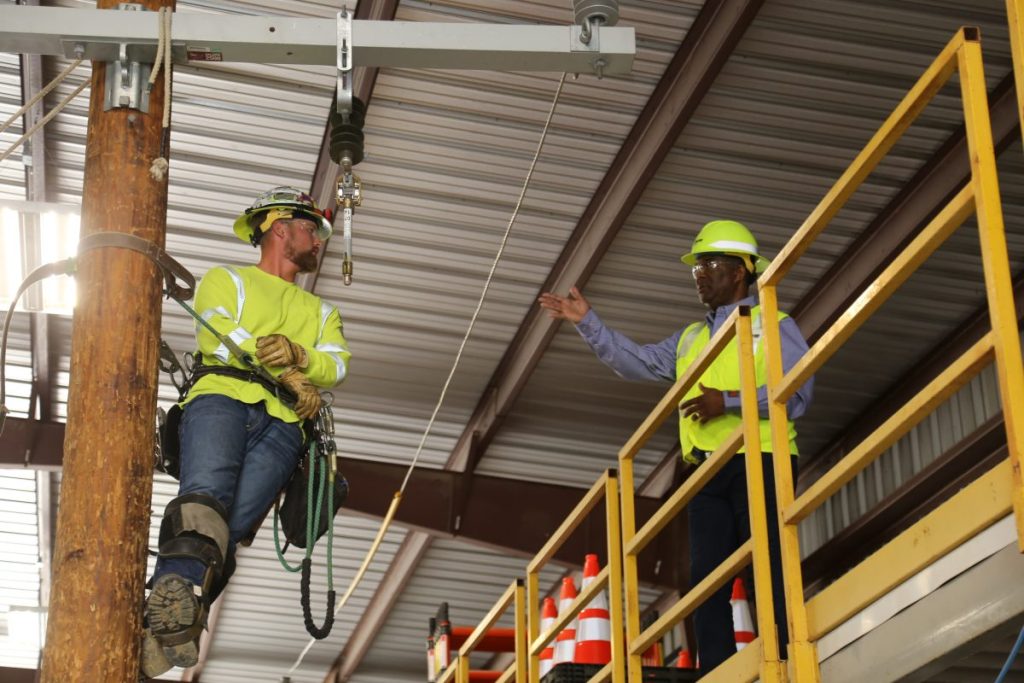
Patrick Smith, right, senior vice president of Operations and Technical Services for Ameren Illinois, shares some safety advice from Ameren Illinois’ Metro East Training Center in Belleville with apprentice lineman Wyatt Kapper, left, who is based in Decatur, Ill. Smith said to always lead with competence over confidence … competence is a behavior, while confidence is a feeling. (Photo courtesy Ameren Illinois)
By MELISSA CROCKETT MESKE
[email protected]
We all know how impactful case studies can be to business, industry and economic growth as well as to development. The same can be said for what the Illinois Business Journal now introduces as a regular feature: Careers in View.
This is planned to be a career study: A look at professionals and their career journeys. A unique take on a case study. A look at what inspired them, the steps that led them forward, and how they ended up where they are today. Think of it as somewhat of a job shadow in print.
If you have someone in mind to be considered for a future featured Careers in View piece in the Illinois Business Journal, email Managing Editor Melissa Crockett Meske, [email protected], with details (and a photo) of the person to be considered.
Meanwhile, let’s get started with the inaugural career study. The IBJ developed this first one as a six-part Q&A with Patrick E. Smith Sr., with help from the Ameren Illinois Communications team.
Smith is the senior vice president of Operations and Technical Services for Ameren Illinois. His career journey leading to his current SVP position, however, began at the former Union Electric Company in St. Louis, prior to when that company merged with two Illinois utilities to become Ameren Corporation.
His journey began in 1985 as a meter reader. He went on to complete a lineman’s apprenticeship and has since proven himself to be a brilliant leader who also earned his executive master’s degree from Washington University St. Louis.
A native of East St. Louis, he has built a 39-year career in the utility industry. He and his wife Crystal reside now in Swansea, Ill. The couple not only share a son and daughter; they also share an employer. Crystal Smith is Ameren’s director of Diversity, Equity and Inclusion.
IBJ: So, what was it that inspired you to work in the utility industry, in the line trade?
Smith: I truly believe the seed of interest was planted subliminally, more than a decade prior, like a “sleeper dream,” waiting to be activated.
Years ago, after a power outage in East St. Louis, as an 8-year-old boy, I peered out the kitchen window into my backyard to see something I had never before seen. It was a Union Electric truck and crew there to restore power to our home. I just remember looking out the kitchen window, looking at the guy in the aerial truck, lifted up, working. It was novel for me and very interesting to see.
Years later, I worked in the East. St. Louis office of Union Electric as a meter reader for about 18 months. Then I bid on an apprentice lineman job. I was successful, which meant I had to buy my own belt, climbing tools and hand tools. I bought them from a retiring Union Electric lineworker named Harry Niedermeyer.
When I met with this gentleman, I realized that he was the guy who had been in my backyard when I was 8 years old. The guy who I first saw doing line work more than a decade earlier, was the guy who provided me with the tools I first used, to enter the trade.
That was Smith’s dream activation…
IBJ: Can you share some details of your apprenticeship and training experiences?
Smith: In 1991, I completed a 48-month apprenticeship training program in 42 months. I was paired with another apprentice, and we did everything together. Our days were always interesting, but rarely easy. Training as an apprentice is a mental and physical challenge. I better understood the need for the intensity, later, when I became a journey lineworker.
There are endless situations that lineworkers will be faced with that require sharp minds and durable bodies. We trained on overhead and underground electrical distribution and even had the opportunity to do some transmission and substation work. While not overjoyed while I was going through it, I now look back on my apprentice lineworker training with fond memories and appreciation.
IBJ: How long were you a lineworker, and what were the roles and responsibilities as such out in the field?
Smith: I did 3.5 years in an apprenticeship program, and I worked 3.5 years as a journey lineworker. Most of my time I was a crew member; however, I did get the opportunity to rotate into crew leader and first responder roles.
IBJ: So, then what made you want to go into leadership in the industry?
Smith: I did not have a burning aspiration to stop doing linework and go into leadership; but I did want the opportunity to interview, to understand the process and gain insights on how to be prepared when that opportunity came again. I always thought I was designed to coach and lead, and my farsighted view included me in a leadership role.
My passion is coaching and that is why I have always coached youth sports. I see leadership in the industry, not measurably different than coaching a sports team. Coaching is something I enjoy, and if I could lead in that fashion, I knew I would enjoy being a leader with our company.
IBJ: What was the transition like for you from field work to office work? Did you face challenges, and if so, how did you overcome those challenges?
Smith: Transitioning from working in the field to working in the office was initially highlighted by the fact that I wore polo shirts and slacks to work. Seems like a small thing, but I had never had a job where I dressed business casual or business. I had to go shopping! But that turned out to be the least of my blind spots.
Being promoted into leadership of the people who trained you was more difficult than I imagined. My perception was my reality, and I sensed I wasn’t the preferred choice by many of the veteran coworkers. There had been a crew leader, who most assumed would land the job including me, and it was a bit of a surprise when it was announced that I got the job. This was also the first year our company utilized an interview committee, and two of the four committee members had no ties to the operating center.
So, while I was surprised, I wasn’t overwhelmed and although I faced an obvious bit of resentment, I felt ready to lead. This was 1995, and frankly there were some biases I also had to navigate. This was not new to me, and I understood excellence of performance would supersede all man-made prejudices. So, I focused on serving my team with excellence and over time, I gained the respect of the teams.
IBJ: Last question — What advice from your career journey can you share now with others who may want to become an executive or run their own company one day?
Smith: I am not sure how I encountered this quote by Theodore Roosevelt, but it has been one of my key motivators as long as I can remember. He said, “Do what you can, with what you have, where you are…”
Focusing on making the best of your situation and demonstrating to yourself, you have the capacity to be an additive influence, is a liberating and inspiring investment.
My father used to tell me, you can fool others, but you can’t fool yourself. There are endless recipes to becoming an executive in the industry; I will share three of many ingredients that I feel can be helpful:
- Develop a default sense of curiosity. Question most things and maintain a thirst for “why,” and not just “how” and “what.”
- Read something every day that improves your understanding of the business you seek to lead. As little as 15 minutes daily can change your trajectory.
- Engage people with fairness and empathy. If you get the “people thing” right first, everything else is just easier.
At the end of this Q&A, Smith further noted some recent successes shared among his Ameren Illinois colleagues:
“At the 39th annual International Lineman’s Rodeo held in Overland Park, Kansas, Ameren Illinois placed fifth in the ‘Journeyman Best of Best’ category. We also had 10 other competitors or teams finish in the top ten of various events. Ameren was further inducted into the Fair360 Hall of Fame. Ameren is one of only 12 companies to join the national Hall of Fame and is the first utility to do so. Ameren’s DE&I initiatives have been ranked No. 1 on the Fair360 Top Utilities list every year from 2016 to 2022 and has also been included on the Top Utilities list annually since 2009.”
(Editor’s note: This story also appears in the September 2024 print edition of the Illinois Business Journal.)
Related Posts