Farmers feeling pinch of economic downturn
By DANIEL GRANT
FarmWeek
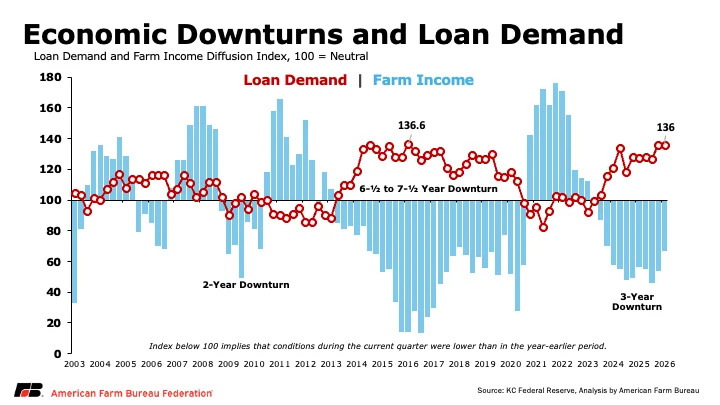
The U.S. farm economy is in the 12th consecutive quarter of an economic downturn, according to data from the Kansas City Fed’s Agricultural Credit Survey.
USDA estimated U.S. net farm income could decline by $1.2 billion (0.7 percent) this year, compared to 2025, in its most recent projection last month.
“We’re just kind of trying to survive and not pull equity out of what we already earned,” said Ron Haase, a FarmWeek CropWatcher from Iroquois County. “We’re cutting back on expenditures and inputs. But most of that stuff we’ve been doing for several years, so there’s not much more we can cut.”
The situation started building five years ago, according to John Newton, American Farm Bureau Federation vice president of public policy and economic analysis.
“The inflationary period that began in 2021 dramatically increased the cost of doing business on the farm,” Newton wrote in a recent Market Intel, adding farm production expenses have risen sharply, with total expenses up 34 percent, or $120 billion, since 2020 and annual gross farm production expenses now approaching a half trillion dollars nationwide.
“Given the cumulative effect of inflation, new economic pressures on input costs such as fertilizers and fuel, and crop prices below breakeven, how long the current downturn lasts will depend a lot on congressional action in the coming weeks and months,” he noted.
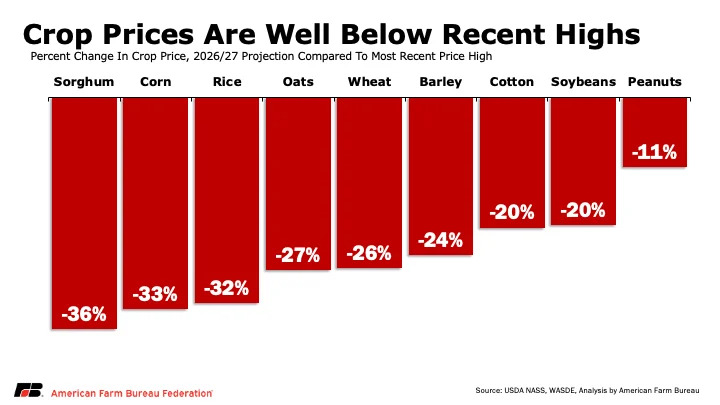
While major crop prices are expected to rebound slightly in 2026, prices for this year’s crops are anywhere between 11 percent and nearly 40 percent below levels reached only a few years prior. This price-cost squeeze has resulted in an erosion in working capital, near-record demand for loans and, in some cases, farm bankruptcies.
In fact, 62 farm bankruptcies were reported nationwide in April, a 130 percent jump from April 2025 and the highest monthly total since February 2020.
While loan demand is at near-record highs — behind only 2016 levels — this demand is likely to service lines of credit needed to keep the farm afloat through the trough, according to Newton.
“The direction of grain prices and the related decisions about storing or selling crops will continue to be impacted by how changing interest rates shape overall financial market conditions,” said Joe Camp, of CommStock Investments. “Market interest rates have moved higher independently of the central bank rate, increasing borrowing costs for producers and raising the opportunity cost of storing crops and other commodities.”
Haase therefore is among many farmers who are scaling back capital purchases and using other measures to reduce input costs such as scaling back fertilizer rates and switching to generic herbicides and fungicides.
“The past year’s tight margins are leaving us with less equity to pull off without borrowing money to cover all these expenses,” said Haase, who can only hope for good crop yields to boost income. “I feel we have a good stand of crops, so that’s a good start.”
The University of Illinois’ latest crop budget estimates published online at farmdocdaily.illinois.edu project average crop prices of $4.50 per bushel for corn, $11.50 for soybeans and $6.60 for wheat for the season, prior to a recent bearish run in the markets.
The price projections combined with high input costs would result in negative returns for corn (between minus-$45 and minus-$91 per acre) with slightly positive results for beans.
“We increased prices in our budget (compared to January), Gary Schnitkey, University of Illinois professor and Soybean Industry Chair in Agricultural Strategy, recently told DeLoss Jahnke of the RFD Radio Network. “On the revenue side it’s positive. But, it still doesn’t cover all the costs for corn.”
One area of the farm economy that remains resilient is farmland values. The Federal Reserve reported farmland values and values for non-irrigated farmland continue to see modest year-over-year growth and have shown no major signs retreating from the elevated values. The strength in farmland values has helped to keep equity measurements like the debt-to-asset ratio relatively low despite record farm debt and a weak farm economy, Newton said. At the same time, strong land values can improve a farmer’s access to credit by providing collateral for borrowing and helping bridge short-term cash flow or liquidity challenges.
“However, because land itself is not a liquid asset, higher land values do not necessarily translate into immediate or expanded access to working capital,” Newton noted.
There have been a number of tailwinds recently to help the farm economy, beginning with congressional support for ad hoc assistance in 2024, the July reconciliation bill that included significant tax relief and invested in farm risk management programs, new agricultural trade frameworks including the recently announced trade deal with China and strong renewable volume obligations alongside a number of regulatory relief efforts.
Both year-round E15 and the farm bill also have passed the House and await action in the Senate, and President Donald Trump recently hinted at additional economic aid for farmers to help offset rising fertilizer and fuel prices and address catastrophic natural disasters.
Graphics by American Farm Bureau Federation
This story was distributed through a cooperative project between Illinois Farm Bureau and the Illinois Press Association. For more food and farming news, visit FarmWeekNow.com.