St. Louis region anchors emerging I-44 aerospace supply chain corridor
Freightway report identifies 650‑mile supply chain artery linking Midwest to Texas, 1.6M jobs and $250B impact
A new report from the St. Louis Regional Freightway highlights the St. Louis region’s strategic position at the apex of the logistics backbone of America’s aerospace industry, where it anchors an aerospace manufacturing and supply chain corridor stretching 650 miles from the Midwest to North Texas.
 Released during FreightWeekSTL 2026, the St. Louis Regional Industrial Real Estate Market Indicators & Workforce Statistics Report reveals how the Interstate 44 (I‑44) Aerospace Supply Chain Corridor is one of the most concentrated clusters of aerospace manufacturers, defense contractors and suppliers to the aerospace and aviation industry in the United States.
The analysis identifies the corridor—running from the St. Louis region through Tulsa, Okla., and Oklahoma City and into the Dallas-Fort Worth metro area (via I-35 to the south from Oklahoma City) —as home to more than 1.6 million aerospace manufacturing and related jobs and more than $250 billion in economic activity. One in five of those jobs is located in the St. Louis region, underscoring its role as the highest-value node in the network.
The report’s other key findings about the corridor include:
- High Concentration of Aerospace Manufacturing: Aerospace Manufacturing has a Location Quotient of 2.81 along the corridor, a metric indicating that the corridor has a concentration of aerospace manufacturing jobs nearly 3X higher than the national average, reflecting a specialized concentration of production capability. In the St. Louis region, multiple zip code tabulation areas have a location quotient above 4.0.
- Sustained Industry and Job Growth: Aerospace manufacturing employment along the corridor has grown by nearly 40 percent over the past five years, signaling continued reinvestment, while the total jobs impact in the corridor is now 2,150 jobs per mile.
- Infrastructure as a Competitive Driver: More than $1 billion in funded and planned improvements along I‑44 across Missouri are enhancing reliability and transit times for freight, a key factor for aerospace manufacturing supply chains that depend on precision timing and ground transport.
“The I-44 Aerospace Supply Chain Corridor is the logistics backbone of America’s aerospace industry, connecting some of the most important aerospace production centers in the country, and the St. Louis region sits at the point where that corridor begins,” said Mary Lamie, executive vice president of Multimodal Enterprises for Bi-State Development and head of the St. Louis Regional Freightway. “The combination of prime-level manufacturing, multimodal connectivity and workforce strength gives the region a distinct advantage for companies looking to optimize complex supply chains.”
Interstate 44 links a dense concentration of Original Equipment Manufacturers (OEMs), Tier 1 suppliers, Maintenance, Repair, and Operations (MRO) providers and defense contractors that rely on surface transportation to move components and subassemblies between facilities. The corridor allows manufacturers to distribute production across multiple sites yet maintain efficient connectivity to various assembly and delivery points.
Sonaca North America (formerly LMI) is a leading supplier to the commercial, business, regional and defense aerospace markets and has nine factories across the United States, five of which are along or in close proximity to I-44. These include plants in Washington, Mo., Cuba, Mo. and Tulsa, Okla., — all directly served by I-44 — as well as two plants and the company’s headquarters in St. Charles, Mo., just a few miles north of I-44. Every part the company produces at the St. Charles or Washington plants goes to Cuba or Tulsa for surface treatments, with many being shipped from there back to St. Louis or Fort Worth, Texas.
Customers include industry giants such as Boeing and Gulfstream as well as other suppliers like Patriot Machine Inc. and Spirit AeroSystems.
Kevin Goossens, CEO of Sonaca North America, commented on the advantages the corridor provides. “For Sonaca, being in Missouri with locations along the I-44 artery contributes to our success because we can be competitive with other suppliers that may have everything on one campus,” Goossens said. “Easy access and easy connections along I-44 were factors as the company expanded through acquisitions and they continue to support movement of our products between our facilities. It’s the closest we can get to being a one-stop shop.”
St. Louis positioned as prime-level manufacturing node
The report highlights the St. Louis region’s unique role within the corridor, anchored by Boeing’s long standing and continuously expanding defense manufacturing operations and supported by a broader aerospace ecosystem. That ecosystem includes major suppliers and maintenance providers such as Gulfstream, West Star, Lear, Sonaca and many others highlighted in the report, as well as military logistics assets. St. Louis is home to Boeing’s Defense, Space & Security Headquarters, and across its facilities in the region the company produces F/A-18s, F-15EXs, F-47s and MQ-25s.
The region’s position is further strengthened by a planned $3 billion-plus modernization of St. Louis Lambert International Airport, expected to significantly enhance global connectivity and economic impact. Across the Mississippi River, the growing MidAmerica St. Louis Airport is co-located with Scott Air Force Base, which is home to U.S. Transportation Command and Air Mobility Command, creating a uniquely integrated environment where aerospace manufacturing, military logistics and aviation infrastructure converge to support the nation’s most critical defense and supply chain operations.
The region’s position at the convergence of Interstate 44 with I‑55, I‑64 and I‑70—along with access to six Class I railroads, inland waterways and two growing airports—enables it to originate, receive and distribute aerospace supply chain flows in all directions.
The St. Louis region’s broader industrial market strengths also support expansion decisions. Nearly 1.5 million workers, with labor force participation rates exceeding national averages, support advanced manufacturing and logistics operations. The region offers 194.4 million square feet of industrial inventory, including 727 buildings over 100,000 square feet and 17.9 million square feet of available space. It also offers competitive triple net lease (NNN) asking rents, around $6.50 per square feet, and boasts 3.4 million square feet of industrial space under construction as of Q4 2025.
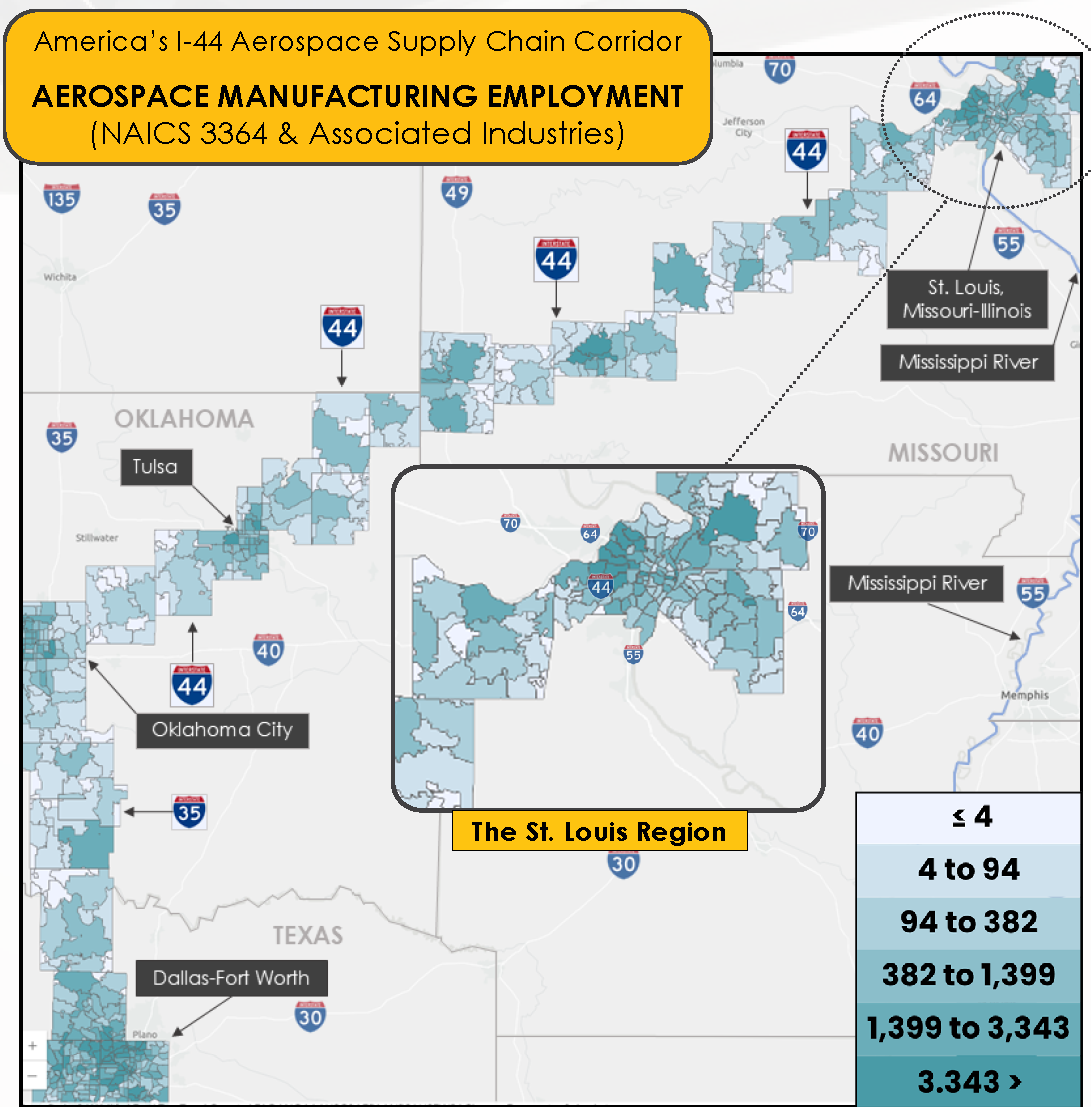
The I-44 map as published on page 7 of the Report.
More than $10.2 billion in industrial investment since 2019 across targeted industry sectors reflects continued confidence in the region’s manufacturing base.
“The I-44 Aerospace Supply Chain Corridor, with the St. Louis region at its apex and origin point, has quietly served as the connective tissue between some of the most important aerospace ecosystem operations in the U.S., giving the region a major competitive advantage in attracting and growing jobs and investment related to aerospace manufacturing,” said Doug Rasmussen, founder and CEO of Steadfast City Economic and Community Partners, which prepared the report.
“The billions in investment that are currently underway in the region in aerospace and defense, major airport expansions, and transportation infrastructure improvements, combined with the density of skilled talent, show site selectors and key industry players that St. Louis is the true anchor of the corridor, supporting some of the most critical manufacturing and logistics operations in the nation,” Rasmussen further noted.
The report was released as part of FreightWeekSTL 2026, held June 8–12. The annual event brings together industry leaders in freight, logistics and transportation to discuss trends shaping supply chains and industrial development.
To learn more or view any of the session recordings, visit FreightWeekSTL.com.
Images provided by St. Louis Regional Freightway.

About St. Louis Regional Freightway
Established as the St. Louis region’s authority for coordinating support for industrial businesses and the logistics infrastructure they depend on, the St. Louis Regional Freightway (the Freightway) provides site selection and business assistance to manufacturing, logistics and multimodal transportation companies and their service providers. As an enterprise of Bi-State Development, the Freightway partners with public sector and private industry businesses to advocate for infrastructure development that supports the movement of freight, leads initiatives to grow the region’s talent pool, and plays a critical role in marketing the region as a world-class manufacturing and distribution cluster within the City of St. Louis and seven adjacent counties in Missouri and Illinois. To learn more, visit TheFreightway.com.