
Careers in View: OSF Saint Anthony’s Dr. Isha McConkey
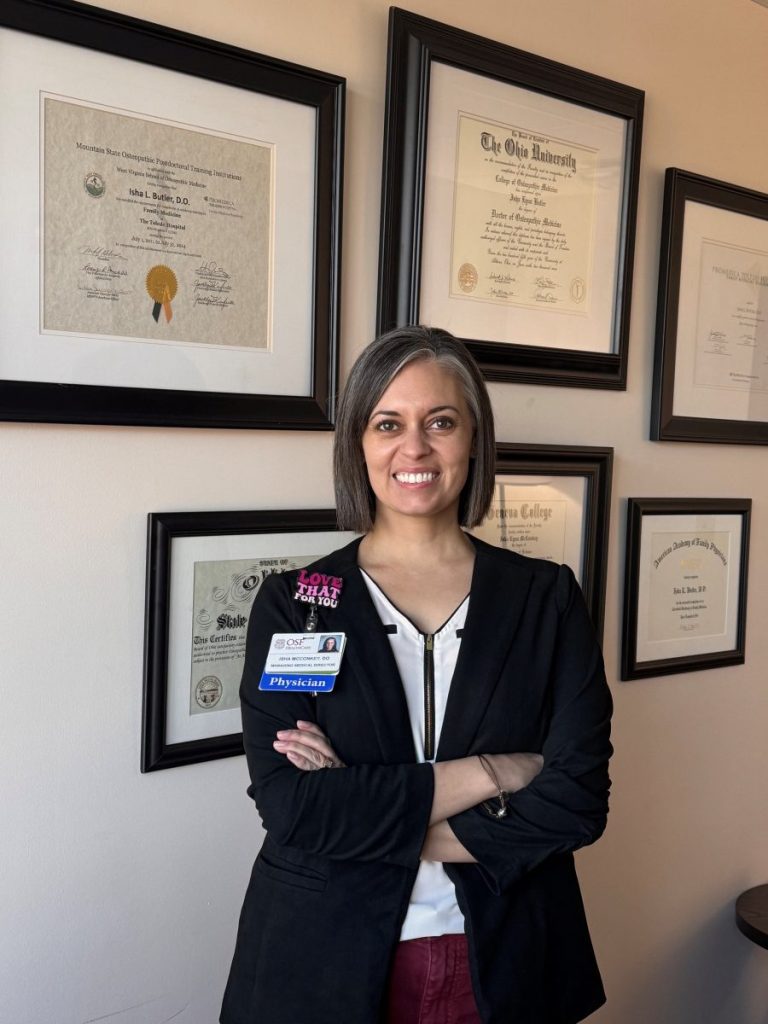
Dr. Isha McConkey pauses for a photo during a recent work day at OSF Saint Anthony’s.
By MELISSA CROCKETT MESKE
Managing Editor, Illinois Business Journal
[email protected]
As a family medicine physician, Dr. Isha McConkey will soon mark her two-year anniversary with OSF Saint Anthony’s, where she has been since April 2024.
She started with the organization as a primary care physician at its Alton clinic and still sees adult patients part-time. However, in November 2024, she moved into an administrative role as Managing Medical Director for OSF Saint Anthony’s ambulatory primary and specialty care providers.
“I am currently responsible for overseeing the clinical excellence of both primary and specialty care clinics across the OSF Alton market,” Dr. McConkey explains. “I am also responsible for holding providers accountable to our standards for high-quality care and patient experience while supporting their growth through education on best practices, evidence-based medicine and patient-centered communication.
“What tends to surprise people most is how much of this role is invisible,” she says further. “When things are going well, no one notices. Much of my work is focused on preventing big problems by addressing small issues early before they turn into larger cultural shifts. My role, then, is to make sure we deliver both care that is clinically excellent and care that feels safe, clear and compassionate.”
Her journey to where she is today has been quite unique, and even unexpected.
“My career path has been anything but linear. And over time, my focus shifted from individual patient care to the systems surrounding it, which ultimately led me into my current role in physician leadership. Looking back, each step was less about following a predefined path and more about responding to what I was seeing in healthcare and continuing to move toward solutions.”
Starting out as a communications major in college with an emphasis on broadcast journalism, she admits that she initially had no interest in science or medicine and was much more comfortable with public speaking, creative writing and studying the effects of communication styles on human behavior.
“However, our pre-med program had no women in it, and I was recruited to help their numbers,” she explains. “I had planned to complete the pre-med program while staying a communications major, but after taking my first biochemistry class, I fell in love with physiology and biology and switched majors. That path allowed me to combine my interest in human behavior and communication with medicine, shaping how I connect with and care for my patients.
She continues: “After undergrad, I knew I wanted to become a D.O. My primary care physician growing up was a D.O., and I was always drawn to how well he cared for the whole person, focusing on diet, physical activity and lifestyle modifications before pharmaceutical interventions. I only applied to D.O. programs and was thrilled to attend Ohio University. After residency, I spent years working as a nocturnist/hospitalist across several health care systems. I worked to aggressively pay off my loans and save enough money to open my own direct primary care practice in Mason, Ohio.”
 Dr. McConkey completed her undergraduate studies at Geneva College near Pittsburgh, Pa., completing the pre-med program and graduating in three years with a Bachelor of Science degree in Biology and a minor in Chemistry in 2005.
From there, she went to medical school at Ohio University and graduated in 2009 with my Doctor of Osteopathic Medicine (D.O.) degree. A psychiatry resident at Wright State University in Dayton, Ohio, followed, albeit briefly. “I stayed there for about six months before I realized psychiatry was not my cup of tea and took time off to regroup,” she shares.
Regrouping also involved raising her oldest child and fostering animals for the local shelter while supporting her family by editing medical school textbooks and professional articles.
“I also developed a deep understanding of the chemistry behind cloth diapering systems and cooking meals from scratch with a focus on nutrition, which later became a foundation for my approach to medicine,” Dr. McConkey says.
“I then realized I wanted to keep my options open across multiple fields of medicine, so I chose a family medicine with obstetrics program in Toledo, Ohio, which allowed me to take care of the whole person across all stages of life,” she adds in.
Dr. Conkey completed a dual-accredited medical residency recognized by both the American Osteopathic Association (AOA) and the Accreditation Council for Graduate Medical Education (ACGME) and took both the Comprehensive Osteopathic Medical Licensing Examination (COMLEX) and United States Medical Licensing Examination (USMLE) licensing exams. She is board certified in family medicine by both the American Osteopathic Board of Family Physicians (AOBFP) and the American Board of Family Medicine (ABFM).
Completing both pathways also means that Dr. McConkey took both sets of licensing exams, which is more extensive than typical. And being certified by both boards is also relatively uncommon, showing dual recognition across both osteopathic and allopathic systems.
The direct care practice she opened in Mason, Ohio, allowed her to provide patients with the care they needed, but at less cost for the care. “Direct care is a physician-led solution to many of our current healthcare challenges. It is similar to concierge medicine, where people pay a monthly fee for access to their physician. However, with direct care, the cost is minimal, and the services are less luxurious but no less personal. I was able to provide house calls and same-day appointments that were relaxed and thorough, often lasting 45 to 60 minutes, and delivering comprehensive, full-person care.
“I offered an in-clinic pharmacy and provided prescriptions at cost,” she explains further. “While this is not an option in Illinois, in Ohio it was a significant benefit, allowing me to offer some medications for as little as $2 per month by passing along wholesale pricing. I was honored to provide this care to my patients, many of whom were uninsured and could not afford traditional health care premiums. I always recommended at least catastrophic insurance, but I was also able to see my patients in the hospital if they were admitted to a facility where I had privileges.”
Dr. McConkey also notes that her favorite part of her practice then was mental health care: “I spent years developing two six-week programs to jump-start my patients’ mental health journeys, one focused on recovery from trauma/PTSD, and the other designed for people who wanted to rebuild their lives from the ground up and transform their health.”
 When asked about what has brought the greatest joy along her career journey, and now in her current role, Dr. McConkey replies: “As a physician, the most meaningful part of my work has always been the connection I build with my patients. There is something incredibly powerful about helping someone finally find answers to a problem they’ve been living with for years, especially when that solution changes the trajectory of their health in a lasting way. Over time, my sense of fulfillment has expanded beyond individual patient encounters. I’ve become deeply invested in identifying breakdowns within health care systems and fixing them so that better care is delivered consistently, not just in isolated moments. Knowing that a change can prevent harm for countless patients is incredibly meaningful.
“I also genuinely enjoy the work of solving hard problems. I’m drawn to situations where there isn’t a clear answer where I can step back, analyze patterns and think through solutions from multiple angles. What makes that process especially rewarding is being able to bring others along with me and help my team see the problem clearly then adopt changes in their workflows that improve the quality and safety of the care we provide.”
The Illinois Business Journal also asked Dr. McConkey to share some advice and guidance for someone who might be considering a similar career journey. Here’s what she had to say:
“Careers in health care, especially as a physician or physician leader, can easily expand to fill your entire life and drain your time and energy. Don’t let them. Yes, this work requires commitment, long hours and sacrifice, but it should not come at the cost of losing the parts of yourself that make you who you are. If rest and peaceful existence are something you have to earn, your career has taken too much. Burnout is inevitable if you don’t have a meaningful life that includes your work, not one that exists only outside of it. If you think you would be just as happy doing something else, you probably should.”
As for a defining moment she experienced that led her to pursue a career in healthcare, and now healthcare administration, Dr. McConkey shares these words:
“I don’t think my path into healthcare or leadership was shaped by a single defining moment. When I look back, it was a gradual process of paying attention to what felt right to me and continuing to move in that direction.
“Early on, I found myself drawn to the intersection of human behavior, communication and problem-solving. As I moved through medicine, that translated into noticing gaps in care and feeling compelled to address them.
“I didn’t start with a clear end goal or a vision of where I wanted to go. Instead, I kept following the problems in healthcare that needed solving,” she further reflects.
And when asked about the leadership practices and principles that guide her past this cairn point on the path of her career journey, Dr. McConkey says, “At the core, my leadership is guided by the idea that when you show compassion to your people while holding them accountable to a high standard, success follows.”
Photos accompanying this story have been provided by OSF HealthCare Saint Anthony’s Health Center.
OSF Saint Anthony’s Health Center is a 49-bed Rural Health designated acute care hospital in Alton, Ill. that serves the residents of Madison, Jersey and Macoupin counties. It is home to OSF Moeller Cancer Center, which provides the latest diagnostic tools and treatment for patients in a relaxing environment. OSF Saint Anthony’s also provides 24-hour access to a physician-staffed emergency department, in addition to cardiovascular, neurology, pulmonology, surgical, rehabilitation services and more. OSF Saint Anthony’s is fully accredited by the Joint Commission for Healthcare Facilities, American College of Surgeons’ Commission on Cancer, American College of Radiology, American Heart Association, IDPH and TJC Primary Stroke Center. OSF Saint Anthony’s is part of OSF HealthCare – an integrated health system with 17 hospitals in Illinois and Michigan and robust Innovation and Digital Health divisions that provide access to specialty care and remote monitoring, helping people receive the care they need close to home. OSF HealthCare is operated by The Sisters of the Third Order of Saint Francis with headquarters in Peoria, Ill.
[EDITOR’S NOTE: We all know how impactful case studies can be to business, industry and economic growth as well as to development. The same can be said for what the Illinois Business Journal has introduced as an ongoing series: Careers in View. Similar to a case study, but instead a career study: A look at professionals and their unique career journeys. If you have someone in mind to be considered for a future Careers in View feature with the IBJ, send an email to [email protected]. Include details about the person and their career to be considered, along with a profile photo and some shots of their career in action.]


