STAR bond program expands statewide: New tool for tourism, retail and job growth
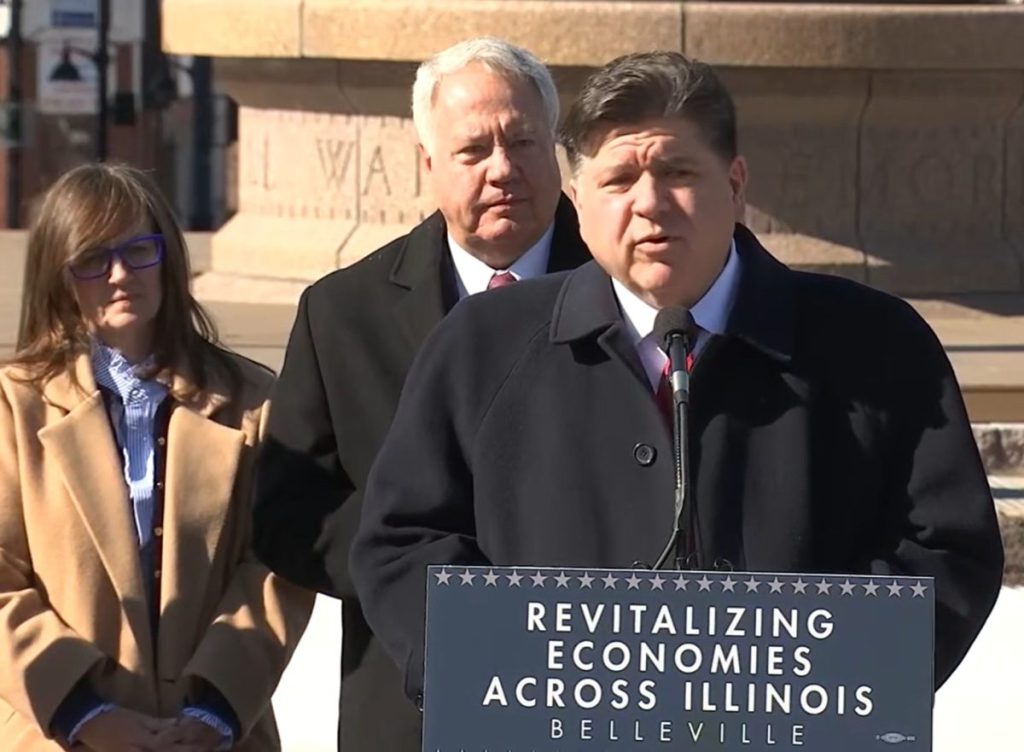
Illinois Governor JB Pritzker was in Belleville on Monday, Feb. 9, 2026, to announce the expansion of the state’s STAR bond program. He was joined by several local, regional and state officials, including State Rep. Katie Stuart and State Rep. Jay Hoffman. (Melissa Crockett Meske/Illinois Business Journal)
By MELISSA CROCKETT MESKE
Managing Editor, Illinois Business Journal
[email protected]
Illinois is expanding a long-dormant economic development financing program statewide, giving communities a new tool to back large-scale tourism, entertainment and retail projects by using future local sales tax growth to help fund construction and infrastructure.
Gov. J.B. Pritzker and state and local leaders announced the expansion Monday, Feb. 9, 2026, in Belleville, where officials said the Metro East is positioned to compete more aggressively for destination-style developments that can keep spending in Illinois rather than sending it across the Mississippi River into Missouri.
“This is yet another way that we are boosting small businesses with the partnership of state and local government,” Pritzker said, calling the program a “sensible and fiscally responsible path” for communities seeking major projects.
The Sales Tax and Revenue, or STAR, bond program was originally authorized in 2010 but remained largely dormant for about 15 years due to issues in how the law was written, Pritzker said.
Under legislation signed in December 2025 (Senate Bill 1911), STAR bond eligibility has been expanded to municipalities statewide.
The program allows approved local governments to issue bonds backed by future sales tax revenues generated within a designated STAR bond district.
State officials said the mechanism is designed to unlock private investment in projects that can attract visitors and spur long-term economic activity.
If all eligible STAR bond projects are completed statewide, Illinois officials estimate they could generate at least $1 billion in sales and create more than 5,000 new jobs.
Illinois DCEO Director Kristin Richards, a Belleville native, said the expansion aligns with the agency’s broader strategy to “drive investment” by pairing local initiatives with state-level policy and financing tools.
The program is aimed primarily at major tourism, entertainment, retail and destination-based projects.
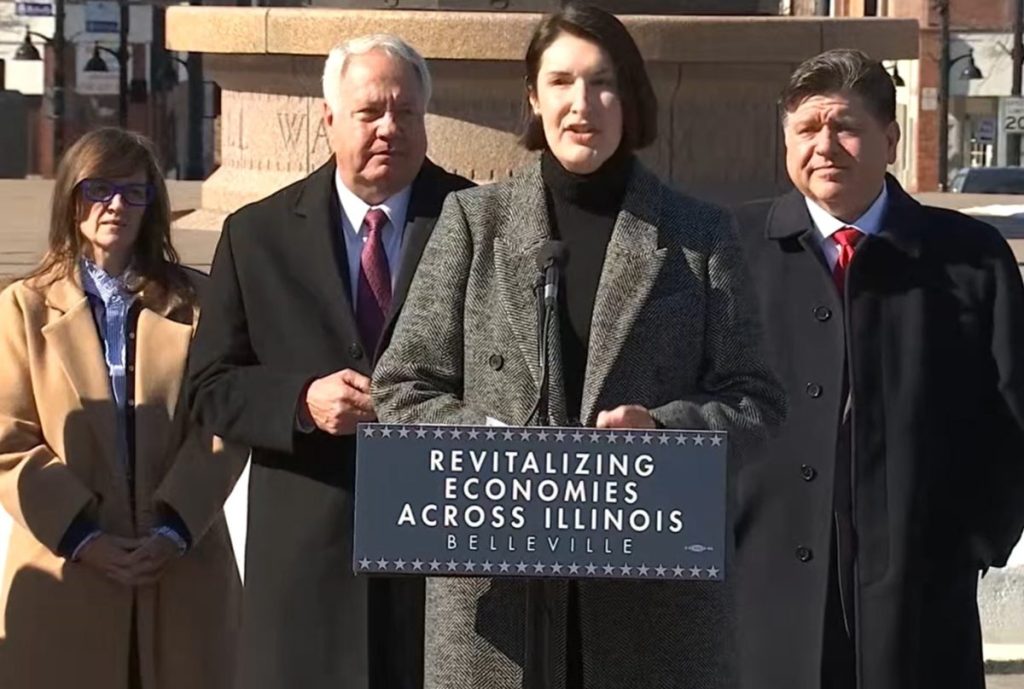
Illinois DCEO Director Kristin Richards addresses those gathered in Belleville on Monday, Feb. 9, 2026, to talk about the expansion of the state’s STAR bond program. Shown from left to right are State Rep. Katie Stuart (D-Edwardsville), State Rep. Jay Hoffman (D-Swansea), Richards, and Illinois Governor JB Pritzker. (Melissa Crockett Meske/Illinois Business Journal)
Metro East positioned for multiple projects
State Rep. Jay Hoffman (D-Swansea) said the updated program is now structured as a competitive process and will allocate a set number of potential projects by region based on population.
Southwest Illinois is designated to receive at least three STAR bond projects, Hoffman said, provided proposals meet job creation and investment thresholds and developers are properly vetted.
Under the program’s requirements, a STAR bond district must generally support at least 300 new jobs and $30 million in capital investment, Hoffman said. Larger “NOVA” districts would require $500 million in investment and at least 1,500 new jobs, Hoffman further explained.
Kyle Anderson, executive director of the Leadership Council of Southwestern Illinois, said the Metro East has long struggled to keep consumer spending from flowing into the St. Louis market.
“Right now, about $3 billion of Illinois money … goes to Missouri and St. Louis,” Anderson said, advocating that STAR bonds could help Illinois communities develop destination attractions that keep entertainment and retail dollars closer to home.
Belleville Mayor Jennifer Gain Meyer said the governor’s visit underscored ongoing state support for projects in the region and described STAR bonds as an opportunity to strengthen local development.
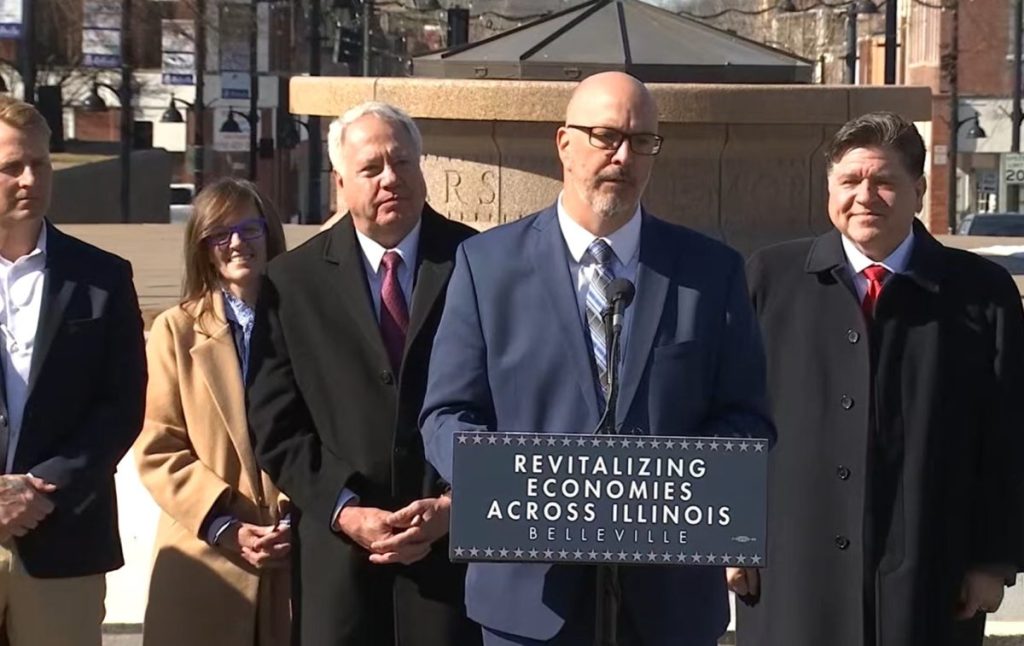
Leadership Council Southwestern Illinois Executive Director Kyle Anderson shares remarks with those in attendance at the official STAR bond program expansion announcement made in Belleville on Monday, Feb. 9, 2026. From the photo’s left, seen are Southwestern Illinois Building and Construction Trades Council Executive Secretary-Treasurer Eric Oller, State Rep. Katie Stuart, State Rep. Jay Hoffman, Anderson and Illinois Gov. JB Pritzker. (Melissa Crockett Meske/Illinois Business Journal)
Labor and workforce emphasis
Labor leaders framed STAR bonds as a tool to create union construction jobs and long-term employment.
Eric Oller, executive secretary-treasurer of the Southwestern Illinois Building and Construction Trades Council, said STAR bond projects would be held to prevailing wage standards, local hiring provisions and apprenticeship utilization, creating “substantial sustaining wages and benefits” that circulate through local economies.
Hoffman added that projects in the region would be built under a project labor agreement.
Next steps for local governments
To participate, units of local government must establish a STAR bond district by resolution and submit plans for state consideration. Districts must be contiguous, have at least 10,000 residents within a five-mile radius, and be located within 15 miles of a state highway or federal interstate, according to the state.
At least half of a district’s area must be in an underserved area at the time the plan is submitted. Districts also may not be in a municipality with more than two million residents.
Interested municipalities and counties must notify DCEO of their intent to establish a STAR bond district by June 1, 2026, by emailing the agency.
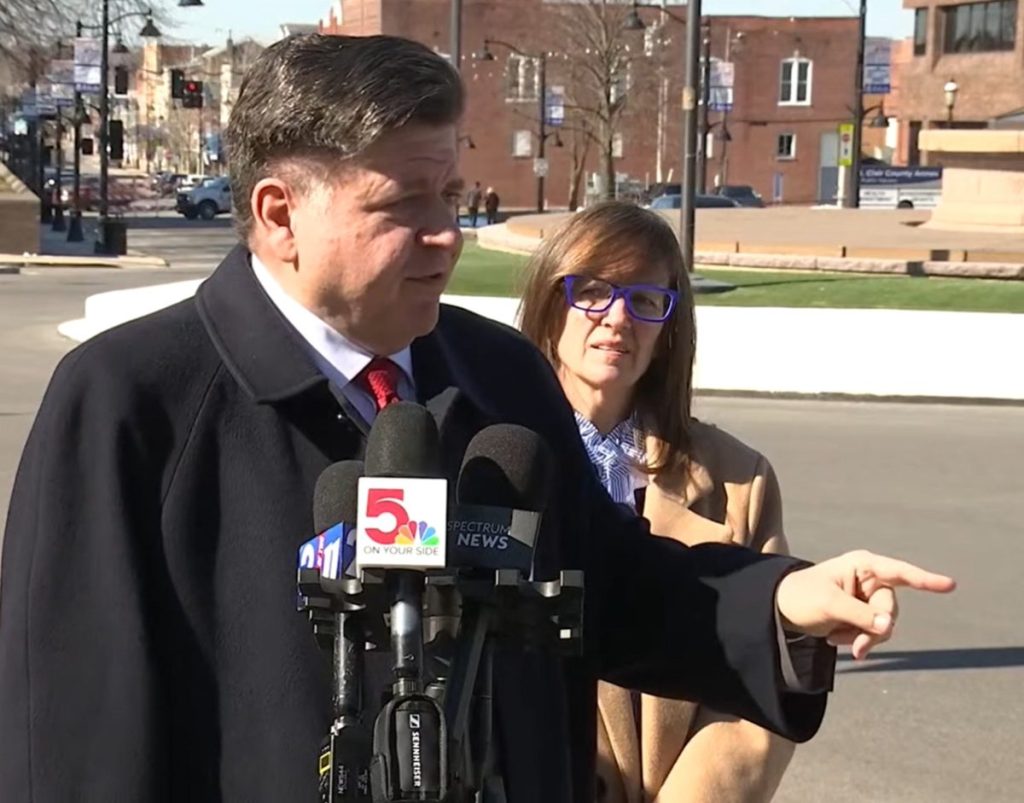
Illinois Governor JB Pritzker fields questions from members of the press following the announcement of the state’s STAR bond program expansion. Local, regional and state leaders gathered in Belleville on Feb. 9, 2026, to jointly announce the program’s expansion and benefits. State Rep. Katie Stuart (D-Edwardsville) can be seen standing behind Gov. Pritzker in the photo. (Melissa Crockett Meske/Illinois Business Journal)