Illinois weighs virtual power plants as energy demand, investment potential converge
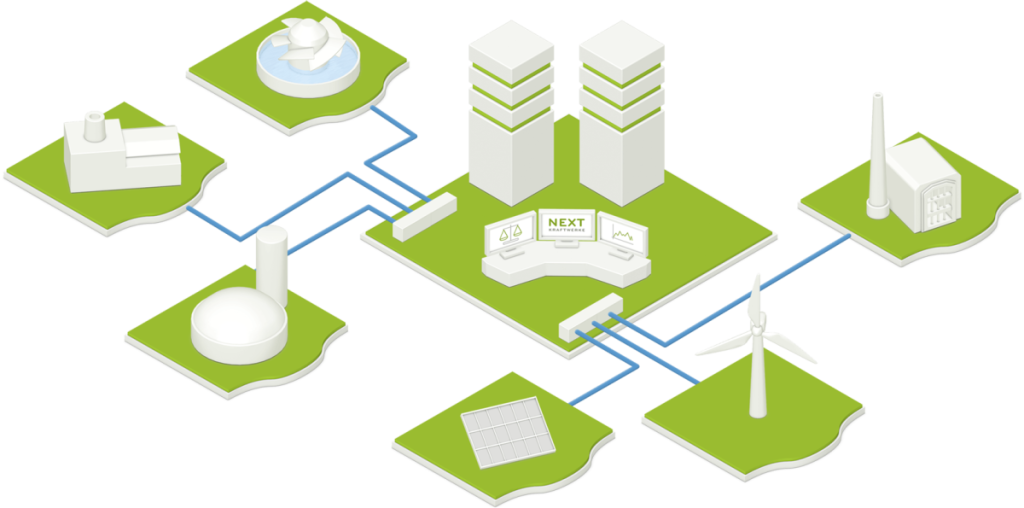
This image is an illustration of a virtual power plant. (This file is licensed under the Creative Commons Attribution-Share Alike 4.0 International license.)
By MELISSA CROCKETT MESKE
Managing Editor, Illinois Business Journal
[email protected]
Illinois lawmakers are considering legislation that could accelerate the state’s clean-energy transition while opening new investment opportunities in solar, storage, and energy management.
The proposal centers on “virtual power plants” (VPPs): Networks of solar-equipped homes and businesses with battery storage that can deliver grid support during periods of high demand.
The timing is critical. Electricity demand in Illinois is forecasted to climb sharply, driven in part by an influx of new data centers, even as the state must phase out fossil fuels by 2045.
Pairing Illinois’ growing base of solar installations with battery storage offers not only a technical solution but also a market opportunity for investors and technology providers.
Incentives designed to scale adoption
House Bill 4120, scheduled for debate during the October veto session, would create Illinois’ first formal VPP program.
Customers who install batteries could receive rebates of $300 per kilowatt-hour, along with guaranteed payments of at least $10 per kilowatt during peak summer dispatches.
For residents and businesses, that translates into faster payback periods and a steady revenue stream from grid participation.
For utilities, it represents a cheaper alternative to building costly gas-fired peaker plants.
“As we work to build consensus and deliver a forward-thinking energy reform package that supports consumers and better positions Illinois, House Bill 4120 is a draft proposal designed to spur feedback before we return to Springfield for veto session. Like the Senate, the House also plans to conduct a public hearing on this measure in the near future,” noted state Rep. Jay Hoffman (D-Swansea) in a statement to the IBJ.
“From the start, my colleagues and I have encouraged stakeholders to share ideas so that we can put forth the best legislation possible. I appreciate the hard work put into this effort throughout the summer months and look forward to building consensus at the capitol with my colleagues on a final plan,” Hoffman added.
Market momentum and investment outlook
Investors are already taking note of the broader VPP market. A recent Wood Mackenzie report projects the U.S. VPP industry could expand fivefold by 2030, reaching tens of gigawatts of capacity and representing a multi-billion-dollar revenue opportunity.
Venture capital and private equity firms have begun backing companies that aggregate distributed energy resources, while large corporates are showing interest in VPP participation as part of their sustainability strategies.
A faster, cheaper path to growth
Research from clean-energy think tank RMI shows that VPPs could meet up to three-quarters of Illinois’ projected new power needs by 2029, reducing costs for utilities and saving the average customer $34 a year.
Just as importantly for investors, VPPs can be deployed in as little as six months — far faster than large-scale power plants or utility-scale battery installations.
“This is an official pathway and timeline for growth,” shared Amy Heart in another media report. Heart is the senior vice president of public policy at Sunrun, which operates VPPs in other states.
“The scale of Illinois’ solar market makes it a natural fit for expansion, and the legislation provides certainty for investors evaluating the state,” Heart added.
Expanding opportunities for industry players
The bill also allows third-party aggregators to manage VPP resources, a model that has spurred significant investment in states like Vermont and California.
That opens Illinois to new entrants, from software startups coordinating distributed energy resources to established energy developers seeking to expand their portfolios.
Longer term, VPP programs could integrate electric vehicle chargers, smart thermostats, and connected appliances, expanding both the technical capabilities and the revenue potential of Illinois’ distributed energy market.
A competitive edge for Illinois
Beyond clean-energy goals, the program could enhance Illinois’ attractiveness to data centers, manufacturers, and corporate buyers seeking affordable, reliable, and sustainable electricity.
By cutting peak costs and reducing volatility, VPPs position Illinois as a more competitive market for energy-intensive industries.
“There’s great untapped potential in demand-response and VPP-type products,” noted Sarah Moskowitz, executive director of the Citizens Utility Board. “If Illinois seizes the opportunity, it can deliver real benefits to consumers, businesses, and investors alike.”
For energy companies, technology providers, and financiers, the state’s move signals a market on the cusp of growth. One where distributed energy can become not just a climate solution, but a profitable investment strategy.