Four public ports in St. Louis region growing through infrastructure investments
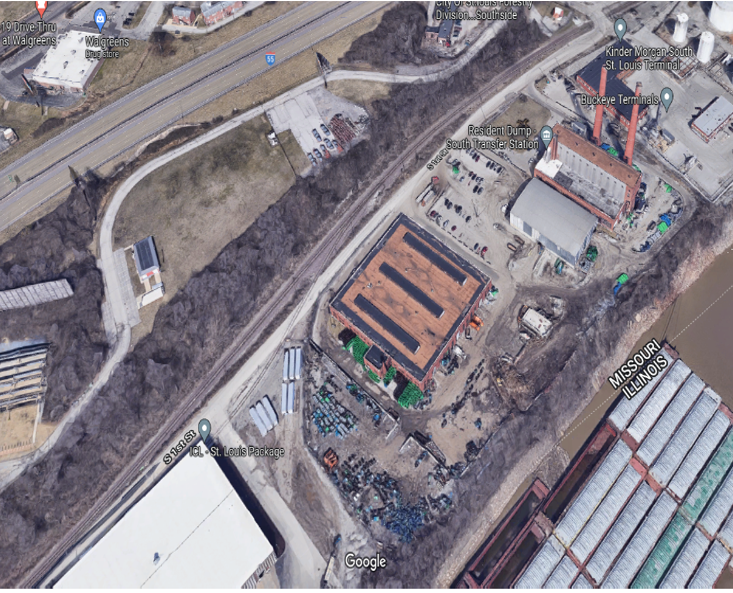
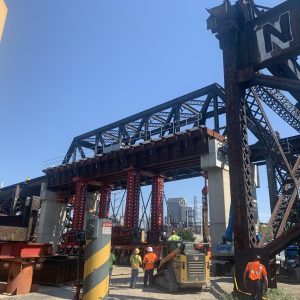
South Riverfront Project.
Four publicly owned ports in the St. Louis region are making major investments in infrastructure to enhance operations, improve efficiencies, and continue to solidify the region’s role as a national leader in freight movement. From multimodal expansions and intermodal rail improvements to new port terminals and enhanced road access, these investments support the continued success of the St. Louis region’s port system.
The City of St. Louis’ Port District comprises 10,000 acres along 19 miles of Mississippi River frontage with direct connections to six Class I Railroads and 22 interstate access points. It handles everything from grain and coal to steel and petroleum, moving about 18 million tons of freight annually through the Municipal River Terminal (MRT) and lies within Foreign Trade Zone No.102. Playing a central role in regional and national commerce, the City’s MRT offers a 2,000-foot dock, 250-ton crane, rail access and 250,000-square feet of warehouse space.
 Recently secured grant funding, paired with private dollars, is supporting rail upgrades at the MRT. Ingram Infrastructure Group continues to expand rail capacity there with the goal of accommodating two-unit trains from just north of the MRT to the Stan Musial Veterans Memorial Bridge (I-70) over the Mississippi River. The St. Louis Port Authority also has plans to redevelop the former South Refuse site adjacent to the Mississippi River and I-55 at 4230 South First Street. This 11.6-acre city-owned location will be repurposed for port operations.
“The project includes the development of a new $13 million South Refuse complex to the west and another $3 million for riverfront site development,” said Susan Taylor, director of the St. Louis Port Authority. “We will issue a request for proposal for the development of this site, and contingent upon funding, the project scope could include 2,400 feet of mooring, new rail infrastructure capable of holding 8 to 9 cars, a 400-foot sheet metal dock, and plans for a 90,000-square-foot warehouse.”
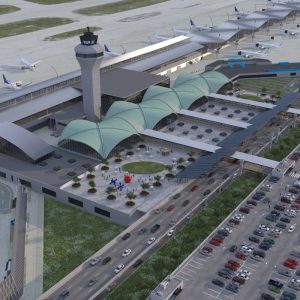
America’s Central Port (ACP), located in Granite City, Ill., is a major multimodal hub with two harbors and a 1,200-acre industrial campus. It’s well known for its flexible infrastructure, which includes dry and liquid bulk terminals, tank farms and a general cargo and roll-on/roll-off dock. ACP continues to enhance its offerings. Recent upgrades include a new entrance road off IL Route 3 to aid trucks accessing the heart of the port’s warehouse and industrial district, and rail improvements at Granite City Harbor. Construction is currently underway for an 80,000-bushel grain bin at the Madison Harbor that will allow ACP to begin accepting a variety of grain from trucks and rail cars simultaneously. It is expected to be complete late summer 2025. These investments are decreasing the time it takes trucks to access the warehouses and increasing efficiencies in both harbors.
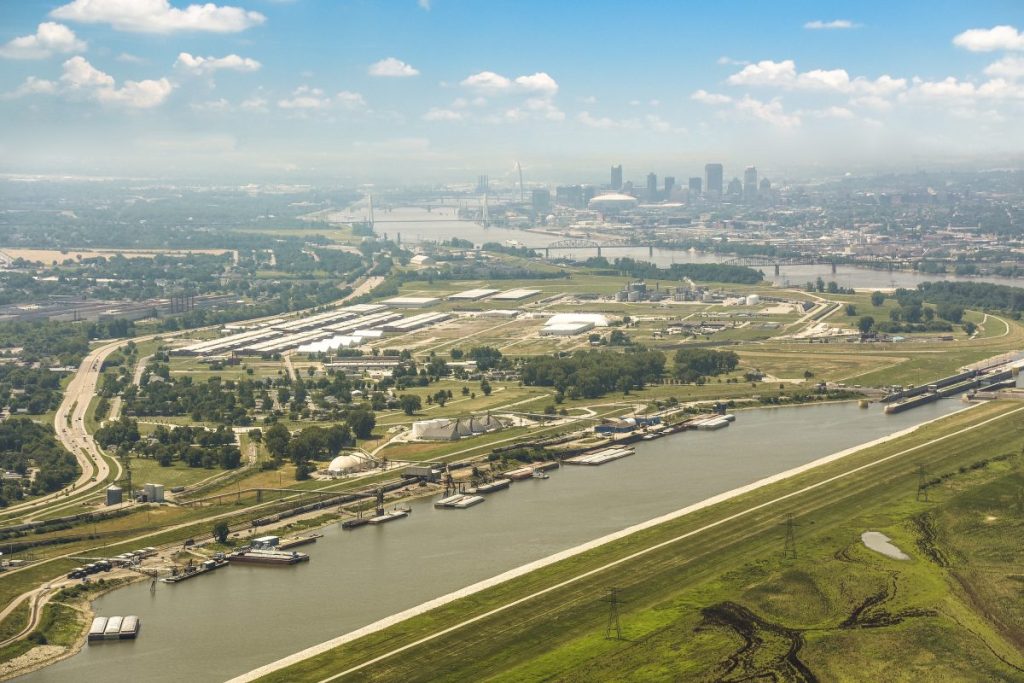
America’s Central Port. (Credit: America’s Central Port)
ACP has several additional projects included in the St. Louis Regional Freightway’s Priority Projects List, including a proposed but currently unfunded $350 million investment that would create an intermodal rail center to manage and reposition sea containers, improving the speed and efficiency of container movement across the region.
“We also have several studies underway to improve safety and sustainability, and further enhance rail and barge efficiencies, and we are working on a new Master Plan to guide port development for the next 20 years,” said Dennis Wilmsmeyer, executive director of America’s Central Port.
Situated south of St. Louis on the Kaskaskia River is the Kaskaskia Regional Port District (KRPD), which covers the Illinois counties of Monroe, Randolph, and the southern half of St. Clair County and incorporates four separate operations. KRPD is the 12th largest inland port in the country. It supports a wide range of cargo, from coal and fertilizer to steel and slag, with strong multimodal access, including river, rail, and highway connections.
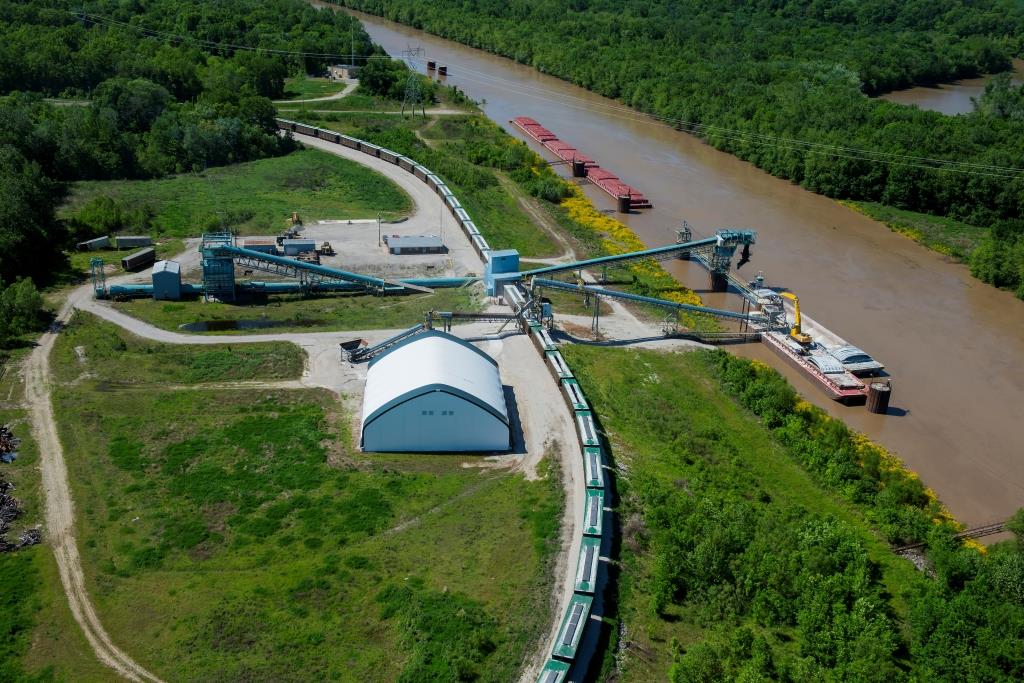
Kaskaskia Regional Port District.
KRPD#2 in Baldwin, Ill., recently completed the installation of a new conveyer that is being used to transload fertilizer from barge to Gateway FS, a tenant that has expanded its dry fertilizer building by 40%. The project was supported by a $2.7 million grant from the Illinois Department of Transportation. Several additional funded projects will improve the safety, reliability, and efficiency of the various other KRPD terminals.
General Manager of KRPD Ed Weilbacher said, “At KRPD #1, we are very close to advertising for the construction of the loop track. Supported by $20 million in state and federal funding, this project is expected to double throughput with an additional two million tons handled per year. We are also very close on advertising for the second entrance road and laydown yards at KRPD #2 to support high truck traffic and improve access.”
The Jefferson County Port Authority (JCPA) is also located south of St. Louis in Jefferson County, Mo., where its largest single project ever undertaken is the development of a multi-modal, public access, industrial port facility.
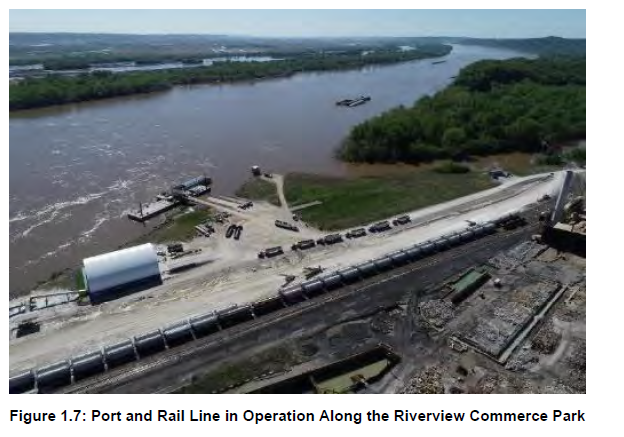
The JCPA’s recent acquisition of approximately 18 acres along the Mississippi River from Riverview Commerce Park, LLC (RCP) supports these efforts. The site in Herculaneum, Mo., is the first publicly owned terminal facility in Jefferson County and is expected to serve as a catalyst for various other infrastructure improvements tied to further port development.
The port terminal at RCP is situated below any lock and dam system, providing a direct shot to the Gulf of America. The terminal has more than 3,000 feet of rail spur located directly off the Union Pacific Railroad, and it is less than two miles from Interstate 55, which provides easy connections to Interstates 64, 44 and 70. It is the proposed site of a planned container-on-vessel (COV) development.
“The new port will be a critical link on the new, all-water, north-south trade lane connecting the Midwest and the St. Louis region to the lower Mississippi River and on to worldwide destinations,” said Jim McNichols, executive director of JCPA.
Construction has begun on a new entrance road to the proposed port terminal and the design of a new bypass road is nearly complete.
“The various enhancements planned and underway not only expand capacity and streamline operations but also position the region to capture a greater share of global trade, particularly through barge and intermodal rail connectivity,” said Mary Lamie, executive vice president of Multimodal Enterprises at Bi-State Development and head of the St. Louis Regional Freightway. “With a Mississippi River location south of locks and ice, a unique stretch of riverfront known as the Ag Coast of America that supports high-volume agricultural exports, and continuous infrastructure investment, the St. Louis region remains an important asset for inland freight and a model of efficiency for the nation.”
All photos provided to the Illinois Business Journal by the St. Louis Regional Freightway/Bi-State Development.
FreightWeekSTL 2025 was hosted from June 2 through June 6. To learn more, or to view past sessions for FreightWeekSTL 2025, visit FreightWeekSTL.com.

About St. Louis Regional Freightway
A Bi-State Development enterprise, the St. Louis Regional Freightway is a regional freight district and comprehensive authority for freight operations and opportunities within eight counties in southwestern Illinois and eastern Missouri, which comprise the St. Louis metropolitan area. Public sector and private industry businesses are partnering with the St. Louis Regional Freightway to establish the bi-state region as one of the premier multimodal freight hubs and distribution centers in the United States through marketing and advocacy for infrastructure development that supports the movement of freight. To learn more, visit thefreightway.com.