‘Talking Transit’ webinar highlights regional direction for 2025
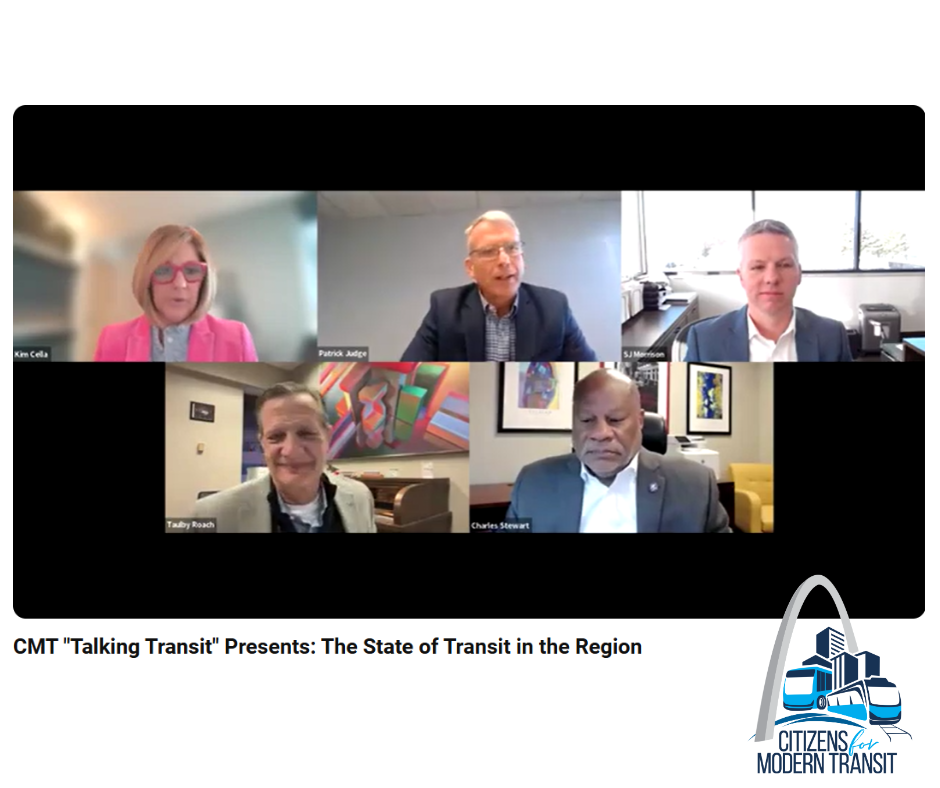
A screenshot of the panelists participating in the Jan. 14 ‘Talking Transit’ webinar hosted by Citizens for Modern Transit via Zoom. (Courtesy CMT)
By MELISSA CROCKETT MESKE
IBJ Managing Editor
[email protected]
Citizens for Modern Transit (CMT) hosted a Zoom webinar on Jan. 14, 2025, where regional transit agencies shared what is coming for 2025, and beyond, for public transit.
Panelists included Madison County Transit Managing Director SJ Morrison, Bi-State Development President and CEO Taulby Roach, Metro Transit COO Charles Stewart, and Gonzales Companies Principal Patrick Judge who also serves as project manager for the Illinois Light Rail Transit project that encompasses St. Clair County’s MetroLink expansion from Shiloh-Scott Station to MidAmerica Airport. The conversation was moderated by CMT Executive Director Kimberly Cella.
Judge kicked off the conversation by detailing the significant movement made on the 5.2-mile extension of the MetroLink light rail system in St. Clair County, Ill., from the existing Shiloh-Scott Transit Center to MidAmerica St. Louis Airport in Mascoutah. Aeriel views of construction work were shared, and the latest timeline was discussed.
“We’re a little over one year from opening up to the public,” said Judge. Construction is scheduled to be completed in 2026, followed by testing and startup, with the official opening of revenue service slated for late Spring to early Summer 2026.
This extension project includes a new MetroLink station directly across from the BLV passenger terminal and parking lot on Airport Boulevard, a 0.3-mile extension of Rieder Road from Wherry Road to Scott Air Force Base’s Cardinal Creek Gate, a new 2.4-mile access roadway from Rieder Road to Airport Boulevard, and a 5-mile expansion of the MetroBikeLink bike trail that will run adjacent to the new alignment.
A total of $129 million in funding for this project was secured through the Illinois Department of Transportation’s transit funds. Remaining costs will be funded locally through St. Clair County Transit District and Bi-State Development.
For his part of the initial dialogue, Morrison talked about all that is underway through the Madison County Transit District (MCT). The public transportation agency rolled out an affordable, real-time, on demand MicroTransit service in Collinsville in 2024 and will be expanding by adding new zones in 2025.
MCT is also enhancing efficiency and rider experiences and now has new real-time vehicle tracking and data-driven fleet optimization to streamline operations and minimize delays. Riders have instant access to real-time arrival updates via web, SMS, apps and Passenger Information Displays.
New solar powered e-ink screens have been deployed at 31 bus stops and will soon be at all five stations. “These are real-time vehicle ‘e-ink’ displays at the bus stops that look simply like a piece of paper, providing information to transit passengers waiting on a bus’s status without a brightly lighted display that might be distracting to other vehicles and drivers or disruptive to those who reside nearby,” Morrison noted.
Also, thanks to a $4.2 million Rebuild Illinois Grant, MCT will construct a sixth, new transfer station along IL-111 to serve the transportation needs at the three commerce centers in what is referred to as “Logistics Valley” in reference to the warehouse district. This will include bus bays for six routes, a police substation, public restrooms climate-controlled passenger lobby and potential childcare facility.
Morrison also shared details about the recently established partnerships continued with Chestnut Health Systems to connect drivers, and passengers in crisis, to trained behavioral health specialists for assistance with mental health and wellness needs, and with Allied Universal Security to assist with addressing passenger issues, deterring vandalism and other security concerns.
Morrison then provided construction updates underway on MCT’s Trails Bikeway System, including a new “Ridge Prairie Trail” coming to Collinsville, and new initiatives underway with RiderFinders’ carpool and vanpool program.
 Stewart provided an overview of all the advancement underway through Metro Transit.
The aging MetroLink light rail vehicle fleet will be replaced in the coming years by new MetroLink train cars. The fleet is modern, state-of-the-art and spacious. Each includes an Onboard Energy Store System, allowing trains to operate up to five miles independent of overhead power and Platform-Sensing Assistance that ensures station platforms are adjacent to doors.
The fleet also features HVAC units, smoke detectors, heated floors, rearview and sideview cameras, digital information signs and audio announcements, fully enclosed operator cabs and designated bicycle spaces. The first new train will be ready go into service in 2027.
Stewart also provided updates on progress underway to add more electric vehicles to the MetroBus fleet. According to Stewart, the Brentwood Garage electric fleet is currently operating 14, 60-foot-long new Flyer Articulated Battery Electric Buses and 10, 40-foot-long GILLIG Battery Electric Buses. The electrification of the DeBaliviere Garage is underway for 10, 40-foot-long hybrid diesel-electric GILLIG buses that are on order and scheduled for production later this year.
Stewart further touched on the new Fare Collection Program that is underway. New Masabi JustRide fare validators have been installed on MetroBus and will be activated in Spring 2025, while Masabi JustRide platform validators for MetroLink will be installed in late 2025. Assembly of the prototype for the new Indra ticket vending machines (TVMs) is in progress, and installation of those new TVMs is expected in late 2025.
An RFP for new fareboxes for MetroBus has been released, and proposals are due in mid-February. A new Metro “Ride-On” app will also be available, offering an electronic ticketing option to riders.
On the security front, Stewart said that work to install secure platforms at MetroLink stations is moving forward. Construction has been completed, and gates are now in use at Emerson Park, Jackie Joyner-Kersee Center, Washington Park and College Stations – as well as the Cortex and Delmar Loop Stations.
Construction on all the remaining stations will be completed in early 2026. The Real-Time Camera Center that opened in recent years remains fully operational and serves as the center of the safety and security methodology by enabling the St. Louis County and St. Louis Metropolitan Police Departments and St. Clair County Sheriff’s Department to proactively monitor the MetroLink system 24 hours a day, seven days a week.
Roach provided an update on the proposed 5.6-mile, new urban alignment known as the St. Louis MetroLink Green Line. He said the alignment would run on Jefferson Avenue, from Natural Bridge to the north, all the way down to Chippewa Street to the south; feature 10 transit stops and a new transfer station connecting existing MetroLink Red & Blue Lines; and help rebuild the city in a way that is conducive to a new design paradigm.
The project is moving towards 30 percent design completion and is under federal environmental review. Nearly 60 public outreach engagement events have been held since May 2024, allowing area residents to weigh in on the proposed project.
Additional public meetings are slated through spring 2025. The revised cost estimate will be determined by next spring or summer so that a highly competitive application can be submitted to the federal government in hopes of securing federal funding to cover 50 to 60 percent of the estimated $1 billion project cost.
Transit officials wrapped up the forum by addressing attendee questions tied to funding differences in Missouri vs Illinois, service improvements, what is fueling ridership increases and more.
Noting how businesses can get involved in all of this, Stewart said that “businesses can sponsor bus shelters,” and Cella shared that they can also be a part of CMT’s bus bench-placing program.
Closing out the Zoom panel conversation, Cella added, “Today’s discussion reinforced a distinct level of optimism as it relates to local transit expansion and advancements. We appreciate the insights from these industry leaders and all the tireless efforts that have gone on behind the scenes in recent years to make all of this come to fruition. The future of transit is bright.”
To learn more about Citizens for Modern Transit or to view the Talking Transit event in its entirety, visit www.cmt-stl.org.