Ironworkers Local celebrates 100 years
By RANDY PIERCE
[email protected]
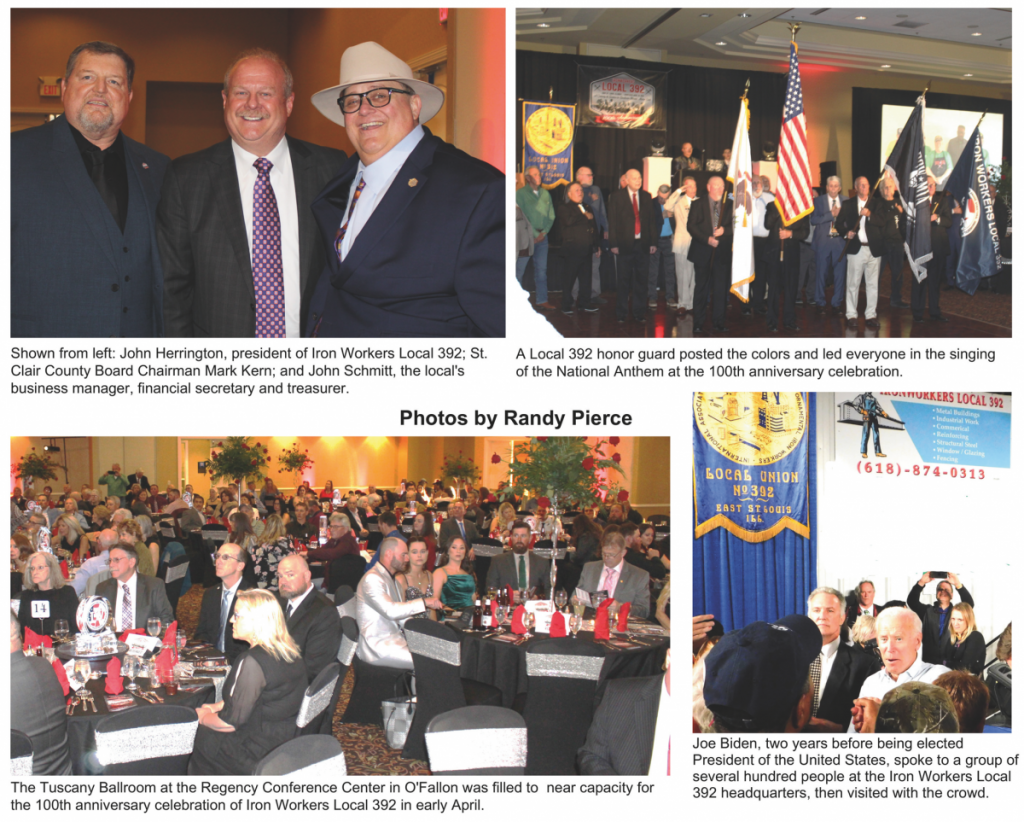
Thousands upon thousands of people in southwestern Illinois have been touched by the impact resulting from the work of Ironworkers Local 392 of East St. Louis which celebrated its 100th anniversary at a gala event held at the Regency Conference Center in O’Fallon in early April.
For those who have been inside various major structures, crossed assorted bridges connecting this part of Illinois with the St. Louis area, been hospitalized, attended classes in schools, colleges and universities, used fuel for their vehicles, received utility power, worked at or visited some of the region’s top factories and industrial sites or attended services at some of the churches in this area, the dedicated expertise of the iron workers has played a major role.
Among the countless projects these iron workers have been involved in is the building that serves as the home of local International Union of Painters and Allied Trades District Council No. 58, just south of Woodland Park at 940 California Avenue in Collinsville. That building was constructed in 2002 by Iron Workers Local 392 with the help of many of its apprentice members.
With a crowd made up of over 500 members of Local 392, their spouses, friends and supporters in attendance, its celebration, consisting of a dinner-dance along with an abundance of fellowship and camaraderie, in observance of a full century of existence, recognized not only the major players in the organization but also its hard-working front-line men and women who have made careers out of this important aspect of the trades industry.
Currently, Local 392 has 670 members, according to its business manager since 2018, John Schmitt, including retirees, 330 journeymen and 70 apprentices. One of the highlights of the celebration event was the distribution of a commemorative history book outlining the origins, growth and progress made by Local 392 through times that have been both prosperous and depressed.
The book, which along with a written narrative about the 100 years of Local 392, also includes dozens of black and white and full-color photos from its archives, plus a large number of supportive advertisements from other union groups, elected officials at both the local and state levels, businesses and pertinent organizations.
Expressing optimism that Local 392 will continue in a positive direction beyond its first century, Schmitt described the accomplishments achieved by its members as “humbling and unbelievable.”
Of the many outstanding examples of what these iron workers have done, one merely can look to the west from one of many points in the Metro-East area and admire the craftsmanship that has gone into the Stan Musial Veterans Memorial Bridge crossing into St. Louis which was finished in February of 2014.
It was on April 10, 1924, that Local 392 was created and granted a charter after being separated from a similar group representing the St. Louis region, one of the justifications in doing this being cited as the existence of other individual building trades unions based in East St. Louis. In conjunction with this action, Local 18 in St. Louis dissolved and became local 396.
All of those organizations’ origins go back to what became known as American Federation of Labor’s Bridge and Structural and Iron Workers group which was formally chartered in 1896 and later called the International Association of Bridge, Structural and Ornamental Iron Workers.
After a slightly unsettled period in the 1920s when there were some disputes concerning the eligibility of elected union officers, Local 392, which had set up an office in East St. Louis, contributed during that decade and the next one to the construction of a power plant along the Mississippi River in Sauget, built and expanded furnaces at Granite City’s steel manufacturing plant and erected what would become the MacArthur Bridge.
The initial impact of the Great Depression, which began in 1929, was initially minimal for the iron workers union members, according to the aforementioned history book, who were earning what for then was a decent wage of $1.75 per hour but it had been lowered to $1.47 in the aftermath of widespread unemployment and remained there until 1937.
Also noted in the book was how the “labor friendly” New Deal reforms from United States President Franklin D. Roosevelt helped turn the situation into a more positive direction with the hourly pay rate reverting to $1.75 by 1940.
Union iron workers throughout the nation, including those with Local 392, got additional work as a result of World War Two as it related to military and defense spending.
After the war ended, the Monsanto Company chemical plant in Sauget was one of the major projects undertaken by Local 392 along with a telephone service structure in East St. Louis and the expansion of the Union Electric power plant in Venice.
The late 1940s also saw the regional ironworkers play a major role in significant projects like expanding the MacArthur Bridge, construction of the Chain of Rocks Lock and Dam in Madison County and a power station in East Alton.
Wage escalation saw the hourly rate climb to a top-scale $3.20 by 1954 with this decade marked by Local 392’s visibility increasing markedly with the construction of the St. Clair County Jail, two elementary schools, a new municipal government building and Memorial Hospital, all in Belleville.
Upgrades and additions to Belleville Township High School, St. Elizabeth’s Hospital, the Stag Brewery, also all in Belleville, plus Christian Welfare Hospital in East St. Louis, provided much work for the Local 392 professionals around the same time period.
Helping the Shell Oil Company refinery in Wood River grow was one of many project highlights for Local 392 in the 1960s along with the expansion of the Olin Mathieson Chemical Corporation plan in East Alton while, further to the south, the building of the new Baldwin Energy Station ended up having a major impact on the area.
Civil rights conflicts and tensions occurring throughout the nation that also touched East St. Louis were cited as factors in the relocation during the 1960s of Local 392’s union hall to a new facility at 2995 Kingshighway at the north end of Washington Park, west of Collinsville and east of Fairmont City. That location, which is still the home base for Local 392 today, was visited in 2018 by incumbent United States President Joe Biden, who delivered an address to hundreds of people present then, two years before he got elected to the nation’s highest office.
In 1968, the 300-bed hospital at Scott Air Force Base which included the work of Local 392 members, was opened while they also utilized their skills in crafting significant projects on the campus at Southern Illinois University Edwardsville and renovations at the Roxana-Wood River area refineries.
The local’s reach went further south again in the 1970s with a five-building project at the Rend Lake recreational area and a 400-patient security hospital in Chester. Also, during this decade, sizable projects for Local 392 consisted of the General Tire Company plant in Mount Vernon, the Randolph County Courthouse and the Kaskaskia River navigation area.
Among the most major highly visible projects in the region which Local 392 played a lead role in making happen came forth from the late 1970s into the 1980s, these being Melvin Price Locks and Dam on the Mississippi River and the Jefferson Barracks Memorial Arch Bridge, connecting lower St. Clair/north Monroe counties with south St. Louis County.
The 1980s additionally saw Local 392 involved in the $6 million Belleville National Bank office complex on the public square, the $85 million Clark Bridge connecting Alton with West Alton and one of its most distant projects, Sarah Bush Lincoln Health Center in Mattoon, on the eastern side of Illinois.
During the final decade of the 20th century, the iron workers local for this region worked on a new health care services building at Memorial Hospital in Belleville and the Casino Queen riverboat casino and hotel that helped boost the economy in East St. Louis.
By comparison to those early hourly wages mentioned previously herein, by 1999, the rate for Local 392 members was $32.05 per hour. Many worshippers in the region are now attending masses held inside another 1990s Local 392 grandiose structure, the 24,0000-square-foot church at the National Shrine of Our Lady of the Snows.
School districts in O’Fallon and Columbia saw expansions thanks to the help from Local 392 after the new century began while its members contributed to the construction of the Prairie State Energy Campus in Lively Grove Township at the far southeast end of St. Clair County.
With 100 years under its belt, Local 392 has accomplished much for its member workers, including having now reached a total earnings base journeyman package of $70.58 per hour that includes payments to its health and welfare, pension, education and annuity funds.
Randy Pierce is a reporter for Herald Publications, part of the Better Newspapers Inc. media family.
(Editor’s note: This story also appears in the May 2024 print edition of the Illinois Business Journal.)