Recent SCOTUS rulings to impact the workplace, but how?
By MELISSA CROCKETT MESKE
[email protected]
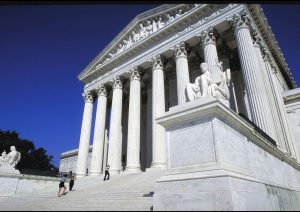
The U.S. Supreme Court Building (Source: Wikipedia Commons)
Given that the Supreme Court of the United States (SCOTUS) is the highest court in the federal judiciary of the country, it has final appellate jurisdiction over all federal court cases, as well as over state court cases that involve a point of U.S. Constitutional or federal law.
Two cases the Court recently and significantly ruled on involved the constitutionality of affirmative action (Students for Fair Admissions v. President and Fellows of Harvard College and Students for Fair Admissions v. University of North Carolina) and what an “undue hardship” really is for an employer under the 1964 Civil Rights Act Title VII (Groff v. DeJoy).
On June 29, a divided Supreme Court ruled that the use of affirmative action in college admissions programs was unconstitutional. Unsurprisingly, this set conversations across academia into an administrative whirlwind.
In the majority decision, Chief Justice John Roberts said the admissions programs could not be reconciled with the “guarantees of the [Constitution’s] Equal Protection Clause.” Justice Sonia Sotomayor, in her dissent, said the Court’s decision “rolls back decades of precedent and momentous progress. It holds that race can no longer be used in a limited way in college admissions to achieve such critical benefits.”
One question that followed this ruling by the Court that essentially dismantled affirmative action in any form is how this might now play out in the work world.
The Wall Street Journal reported that companies are expecting “new challenges to diversity policies,” including a reduction in “racial diversity among the pool of highly educated candidates for future jobs, including those in leadership.” The paper noted that employers were bracing for employer DEI programs, meant to recruit and retain women and underrepresented groups, to come under greater scrutiny.
The WSJ’s Lauren Weber and Chip Cutter wrote in their June 30 report: “They also say the ruling, which prohibits race-conscious college admissions, will lead to challenges to internal diversity, equity, and inclusion initiatives, many of which were put in place or augmented over the past few years. Many large employers have said that affirmative action assists businesses by helping them serve a diverse universe of customers and clients. They have cited research showing that diverse teams are more creative and make better decisions than homogeneous ones.”
USA Today’s Jessica Guynn, in her article about the Supreme Court’s reversal of affirmative action and what that means for workplace diversity, wrote: “…the ripple effects from the ruling could come quickly, starting with the decline in college graduates from underrepresented backgrounds, meaning the loss of ‘a pipeline of highly qualified future workers and business leaders,’ companies from Google to General Electric warned the Supreme Court.”
Southern Illinois University Edwardsville Associate Professor Robyn A. Berkley, Ph.D., MBA, SPHR, weighed in with her perspective on the Court’s affirmative action ruling and what the workplace might see as a result.
“I think that things will change,” said Dr. Berkley, “but only with respect to more accurately reflecting what the Equal Opportunity [Act] states is required. It will change recruiting but will not necessarily change selection because selection is about hiring the best candidate.
“Affirmative action does not have anything to say about who the organization can hire,” she continued. “It only asks them to expand their recruitment pool to ensure there is a level playing field for all. There is nothing that would violate EEO laws if the organization reaches out and expands the pool of applicants they try to attract. The organization should only hire the best candidate regardless of protected class status.”
“Affirmative action in hiring is very different than how it was applied in college admissions. In hiring, the goal of affirmative action is to create a level playing field. It asks employers to make a ‘good faith effort’ to attract and promote underrepresented individuals. Note, it does not say anything about hiring. ‘Good faith effort’ is the language in the guidelines to which employers are held. It means they need to actively recruit from diverse sources. It means they should invest in areas where disparities occur. It means they need to be sure all individuals have access to training programs, so they are ready for promotional opportunities,” said Dr. Berkley.
Dr. Berkley also noted that affirmative action has its greatest impact on recruitment, not really on selection. “Affirmative action is not about QUOTAS,” she emphasized. “Those are illegal under the 1991 Civil Rights Act. Affirmative action is about helping those who are underrepresented in the workplace, and we make efforts by implementing programs to ensure there are opportunities for everyone to grow and develop and be prepared.”
Regarding claims of “reverse discrimination” as a fallout from the elimination of affirmative action, Dr. Berkley noted that, technically, there is no such thing. “Discrimination is discrimination,” she said. “EEO law states when we use race, sex, color, religion, or ethnic origin to make hiring decisions that is discrimination. It works for white males as much as it works for black females. If a company is making a hiring decision that says I will only hire [insert group] that aligns with protected status, it is discrimination. If I say I will NOT hire white males, that is as much discrimination as it is to say I will NOT hire black females.”
Turning to the outcome of the religious accommodations case of Groff v. DeJoy, the U.S. Supreme Court raised the bar on what the level of “undue hardship” should be for an employer faced with accommodating an employee’s religious beliefs but left the actual level to be defined by case and at the state level.
The case involved a postal worker who had declined to deliver Amazon packages on Sundays due to his religious beliefs and the USPS, as his employer, claiming that providing this accommodation would be too substantial a cost for them to bear.
In a unanimous opinion, Supreme Court Justice Samuel Alito wrote, “Title VII requires an employer that denies a religious accommodation to show that the burden of granting an accommodation would result in substantial increased costs in relation to the conduct of its particular business.” However, the Court left the context-specific application of that clarified standard in this case to the lower courts to decide.
Dr. Berkley said that the outcome of this case will likely have employers asking applicants, “Can you do the job, with or without a reasonable accommodation? Similar to the ADA [Americans with Disabilities Act]. If the company states it requires people to work Sundays and asks, ‘Can you do that?’ The onus is on the employee to answer truthfully. It may be more costly because organizations may be required to pay overtime to cover for those who are taking those times off work for religious holidays/accommodations. My thoughts on this right now are that this is not as onerous as it might seem. It will just require more creativity and flexibility to address sincerely held religious practices.”
The IBJ asked Attorney-at-Law Thomas E. Berry with the St. Louis-based firm Jackson Lewis P.C. for input on the Supreme Court’s ruling on affirmative action and how it might impact the workplace. He said, “It will have ripple effects in the workplace and certainly raises a number of questions about future challenges for employers too.” But then he turned the attention toward the second case, stating, “But that is not the most significant decision today for employers. Rather the Groff v. DeJoy decision changing the rules for religious accommodation requests is an even greater decision today than the Affirmative Action decisions.”
Berry then shared an article recently published by Jackson Lewis that noted, “The U.S. Supreme Court has ‘clarified’ and changed the religious accommodation standard under Title VII of the Civil Rights Act that employers and the U.S. Equal Employment Opportunity Commission (EEOC) have relied upon for more than 46 years.”
The article explained that “Under Title VII, employers are required to reasonably accommodate employees whose sincerely held religious beliefs or observances conflict with work requirements, unless doing so would create an undue hardship for the employer. Absent a statutory definition of ‘undue hardship,’ courts have relied on the Court’s decision in TWA v. Hardison, 432 U.S. 63 (1977), for the last 46 years to determine the parameters of the term. In Hardison, the Court stated that requiring an employer ‘to bear more than a de minimis … is an undue hardship.’
“In a unanimous opinion authored by Justice Samuel Alito, the Court changed the test,” the Jackson Lewis-authored piece shared by Berry further noted. “According to the Court, it now ‘understands Hardison to mean that ‘undue hardship’ is shown when a burden is substantial in the overall context of an employer’s business.’ This is a significant change from what the EEOC and courts have stated, and on which employers have relied, for years. The Court declined to incorporate the undue hardship test under the Americans With Disabilities Act, which requires significant difficulty and expense. The Court also declined to determine what facts would meet this new test and remanded the case back to the lower court to decide, setting up what likely will be years of legal battles with courts attempting to apply this new standard.”
TIME writer Sanya Mansoor wrote in her June 29 penned piece: “Other experts argue expanding religious accommodations for employees could also be harmful.” Mansoor noted that these experts believe the Supreme Court’s decision in Groff v. DeJoy tells lower courts to no longer abide by the minimal cost standard that had previously guided them.
“The decision is a long overdue correction to an error that has eroded the protections that Congress enacted to safeguard workers’ rights from destruction by their employers,” cited John Meiser, director of the Religious Liberty Clinic at Notre Dame Law School, as Mansoor shared in her published piece. “For decades, courts have permitted even the richest or most powerful employers to deny religious needs that would have cost next to nothing to allow.”
This story also appears in the August 2023 print edition of the Illinois Business Journal.